
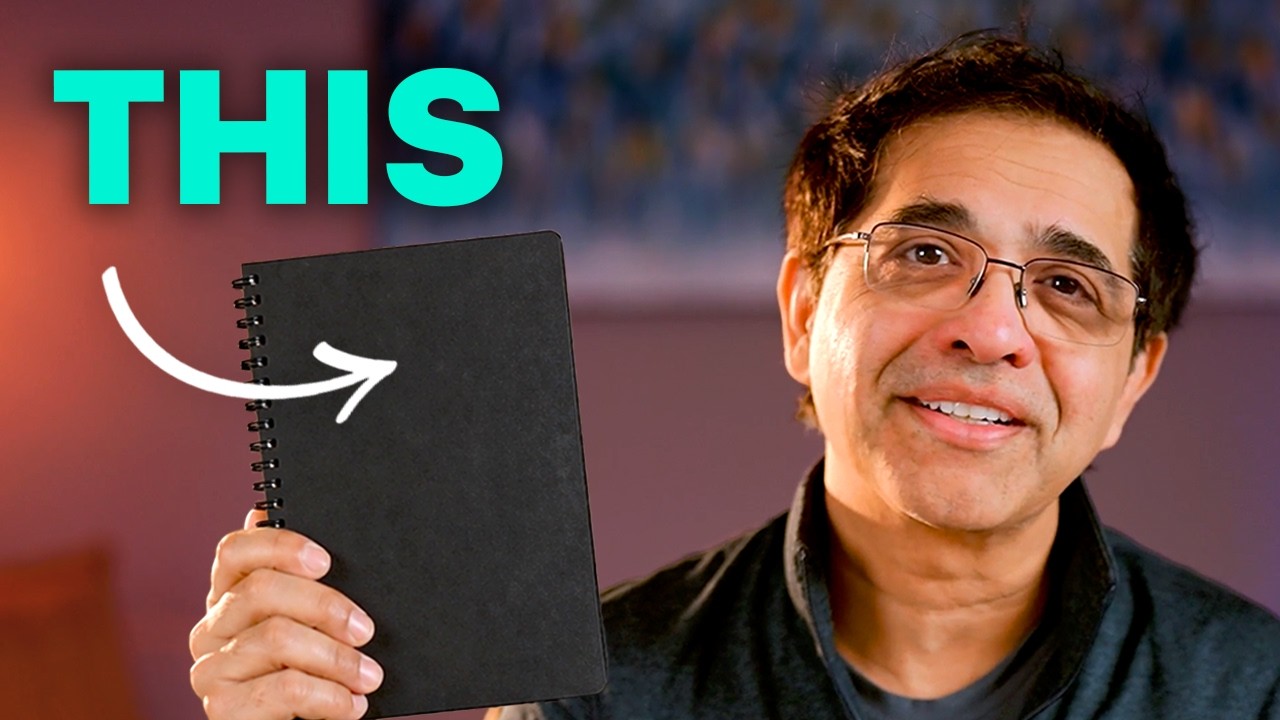
 14:12
14:12
This Simple Technique Will Help You Learn 10x Faster
theMITmonk
To think clearly and learn faster, embrace the power of writing on paper to shape your ideas and emotions.
Executive Summary
The video emphasizes the importance of the forgotten skill of thinking on paper as a means to enhance clarity, creativity, and learning in the age of AI. It presents a framework called the 'three originals'—invention, introspection, and intuition—highlighting how writing by hand fosters deeper cognitive engagement and emotional processing. By integrating paper, keyboard, and AI in a flexible system based on the needs of an idea, professionals can harness their unique human capabilities and produce original thoughts, ultimately shaping their ideas and the world around them.
Key Takeaways
- Start a daily journaling practice using pen and paper to clarify your thoughts and emotions, allowing for deeper introspection and creativity.
- Use paper for brainstorming new ideas without judgment; write freely and messily to encourage original thought generation.
- When facing a blank page, take 15-20 minutes to let your thoughts flow without pressure; write anything that comes to mind, no matter how incomplete.
- Identify when your ideas need freedom, form, or feedback, and choose the appropriate tool (paper, keyboard, or AI) to develop them effectively.
- Incorporate doodling into your note-taking process to enhance creativity and reduce anxiety while working through complex ideas.
Key Insights
- Thinking on paper enhances cognitive engagement, allowing ideas to be physically embodied, which fosters deeper understanding and creativity compared to typing or prompting.
- The act of writing by hand engages unique sensory experiences, creating a 'haptic perception' that embeds thoughts more profoundly in our minds.
- Embracing the discomfort of a blank page is essential for originality; overcoming our inner critic unlocks creativity and leads to clearer, more authentic ideas.
- The integration of paper, keyboard, and AI in the creative process allows for a dynamic flow of ideas, ensuring that each tool is used according to the needs of the thought.
- The three originals—Invention, Introspection, and Intuition—represent uniquely human traits that machines cannot replicate, emphasizing the importance of personal expression in a technology-driven world.
Summary Points
- Thinking on paper enhances clarity, creativity, and learning, making it a vital skill in the age of AI.
- Writing by hand engages different brain areas, improving memory and understanding compared to typing.
- The three originals—Invention, Introspection, and Intuition—are unique human traits best expressed through paper.
- Overcoming the blank page syndrome requires embracing discomfort and allowing free-flowing thoughts without judgment.
- Integrating paper, keyboard, and AI creates a dynamic system for developing and refining ideas effectively.
Detailed Summary
- The video emphasizes the importance of thinking on paper, a skill that enhances clarity and learning, especially in the age of AI. It argues that writing by hand engages our brains more effectively than typing or prompting.
- Research from NTNU in Norway shows that writing on paper activates brain regions associated with ideas and memories, suggesting that this method of thinking is deeply rooted in human cognition and creativity.
- The speaker highlights historical figures like Da Vinci and Darwin, who utilized paper for their groundbreaking ideas, illustrating that even modern leaders still rely on this method to generate and refine their thoughts.
- The framework of 'three originals'—invention, introspection, and intuition—defines unique human traits that machines cannot replicate, emphasizing the need for personal expression and deep thinking in creative processes.
- The video addresses the common fear of the blank page, explaining that overcoming this barrier is essential for original thought. It encourages viewers to embrace discomfort as a part of the creative process.
- Practical advice is given on how to approach writing: quickly form imprecise ideas without judgment, allowing for freedom and creativity to flow without the pressure of perfection.
- The speaker introduces a flexible system for idea development, suggesting that ideas may start on paper for freedom, shift to a keyboard for structure, and finally utilize AI for feedback and refinement.
- Ultimately, the video concludes that while AI can enhance and execute ideas, the initial creation must come from the individual, reinforcing the value of personal thought and the act of writing on paper.
What forgotten skill does the video suggest can help you learn 10x faster?
According to the video, what part of the brain is activated when writing on paper?
What does the speaker mean by 'the three originals'?
What is the main reason people avoid using paper according to the video?
Why does the speaker suggest that writing by hand is beneficial compared to typing?
What does the speaker recommend doing when facing a blank page?
What is the suggested order of using different tools for idea development?
What does the speaker mean by 'desired difficulty' in the context of thinking?
How does the speaker illustrate the importance of the initial creative process?
What is the ultimate takeaway from the video regarding the use of paper?
What is the main forgotten skill for clearer thinking?
The main forgotten skill is learning to think on paper. Writing by hand engages different parts of the brain, enhancing clarity and creativity.
How does writing on paper affect brain activity?
Writing on paper activates brain areas associated with ideas, memories, and learning, leading to deeper understanding compared to typing.
What are the three originals in the context of thinking?
The three originals are invention, introspection, and intuition. These traits are unique to humans and cannot be replicated by machines.
What is the significance of the blank page syndrome?
Blank page syndrome refers to the fear of starting with a blank page, which can hinder creativity and clarity. Overcoming this fear is essential for original thought.
How does haptic perception relate to writing?
Haptic perception refers to the unique physical experience of writing by hand, where each letter is distinct, helping to tag ideas with sensory fingerprints.
What is the first step in the framework of thinking on paper?
The first step is invention, where you generate new ideas without criticism. This involves free writing and allowing your thoughts to flow without judgment.
How can paper help during emotional fog?
Using paper for introspection allows you to label and navigate your feelings. Writing helps clarify emotions, making it easier to process and move forward.
What is first principle thinking?
First principle thinking involves breaking down a problem to its fundamental truths. It emphasizes understanding the core of a problem before attempting to solve it.
When should you use paper instead of a keyboard or AI?
Use paper when your idea needs freedom and space to develop. It’s ideal for initial brainstorming and when ideas are still fragile.
What role does AI play in the creative process?
AI serves as a collaborator and feedback tool once an idea has structure. It can challenge, expand, and refine ideas, but cannot create them.
What is the relationship between speed and depth in note-taking?
Research shows that students who take notes by hand understand concepts more deeply than those who type, as typing often prioritizes speed over depth.
What is the importance of the physical act of writing?
The physical act of writing by hand creates a unique connection to thoughts, making them more memorable and impactful compared to typing.
How can you overcome the fear of the blank page?
To overcome the fear, allow yourself to write anything without judgment. Focus on quickly forming imprecise ideas to break through initial resistance.
What is the cycle of using paper, keyboard, and AI?
The cycle involves starting with paper for freedom, moving to keyboard for structure, and then using AI for feedback. This process can loop as needed.
Why is it crucial to think on paper in the age of AI?
Thinking on paper fosters originality and personal expression, qualities that remain uniquely human despite advancements in AI technology.
Study Notes
The video emphasizes the importance of a forgotten skill: thinking on paper. The speaker argues that while technology has advanced, the act of writing by hand engages our brain in a way that typing does not. Research from NTNU in Norway shows that writing activates areas of the brain associated with ideas and learning. The speaker suggests that in an age where we often outsource our thinking to machines, returning to paper can enhance our cognitive abilities and creativity. This section sets the stage for understanding why traditional methods of thinking are still relevant today.
The speaker introduces the framework known as the 'three originals': invention, introspection, and intuition. Each of these traits is described as uniquely human and essential for deep thinking. Invention involves generating new ideas without self-criticism, introspection helps navigate emotional challenges by labeling and accepting feelings, and intuition focuses on defining problems before solving them. This framework highlights the importance of using paper for these processes, as it allows for a more organic and personal approach to thinking and creativity.
The speaker discusses the concept of 'desired difficulty' in thinking, which suggests that the harder your brain works to generate thoughts, the deeper the understanding. This section highlights the common struggle with the 'blank page syndrome' and how it drives people to seek instant solutions from AI. The speaker argues that facing the discomfort of a blank page is necessary for achieving clarity and originality in thought. By embracing this challenge, individuals can foster deeper cognitive connections and creative breakthroughs.
A key point made is the impact of our inner critic when facing a blank page. The speaker shares a personal anecdote about a friend who struggles with cooking when judged, illustrating how external judgment can stifle creativity. The speaker encourages viewers to silence their inner judge and focus on quickly forming imprecise ideas on paper. This approach allows for freedom in thought and creativity, emphasizing that the act of writing should be about exploration rather than perfection.
The speaker outlines a system for integrating different tools—paper, keyboard, and AI—based on what an idea needs at different stages. If an idea requires freedom, paper is the best choice; if it needs form, then the keyboard is appropriate; and if feedback is necessary, AI should be utilized. This flexible approach allows for a personalized creative process, ensuring that ideas are nurtured and developed in the most effective way possible, depending on their current state.
In this section, the speaker emphasizes that every idea has a journey that requires various tools at different stages. The process begins with paper for initial thoughts, moves to the keyboard for structure, and then to AI for feedback and refinement. This cyclical process highlights the importance of returning to paper when needed, reinforcing the idea that creativity is not linear but rather a dynamic interplay between different mediums. The speaker encourages viewers to embrace this journey to enhance their creative output.
The speaker concludes by reiterating that what makes us human—our emotions, intuition, and creativity—are protected and nurtured through the act of writing on paper. This section serves as a reminder that while technology can enhance our ideas, the initial spark of creativity must come from within. The speaker encourages viewers to make their 'first cut' on paper, emphasizing the importance of solitude and personal expression in the creative process.
The video wraps up with a call to action for viewers to embrace the messy, original ideas that come from thinking on paper. The speaker stresses that every significant advancement begins with a simple idea, and the process of shaping these ideas is crucial. By using paper as a primary tool for thought, individuals can cultivate their unique voice and creativity, ultimately leading to greater personal and professional success. This final message reinforces the video's core themes and encourages proactive engagement with the creative process.
Key Terms & Definitions
Transcript
If you want to think more clearly than 99% of people, learn more quickly, and master almost anything in the age of AI, you need to bring back one forgotten skill. How to think on paper. I've spent decades in boardrooms and tech companies worth billions, and the sharpest thinkers I know still reach for pen and paper. So, in this video, I'm going to share a complete system for how to think, how to learn, how to create using the most powerful thinking tool you already own. One that costs you a dollar. Sure, paper will not replace your keyboard or AI today, but it can make you much harder to replace. So, let's get started. The first thing we want to talk about is why pen is mightier than the prompt. Writing is slower than typing. Typing slower than prompting. But with each step, we hand off one more layer of our thinking to a machine. We humans have been thinking with our hands for thousands of years. There's a university in Norway, NTNU, and the scientists there found that when we write on paper, the parts of our brain that light up are the same parts where ideas, memories, and learning take place. But the world we live in today is very different. We prompt more than we produce. We used to shape ideas on paper. Now we just rent them. We select them from whatever the machine throws at us. As the French philosopher Daycart once said, "I think, therefore, I am." Well, if you outsource your thinking, what's left of you? Here's what surprised me the most. Writing on paper literally shapes your thoughts. That's why the top leaders still think on paper. For instance, Da Vinci kept 7,000 pages of handwritten books, drawings, diagrams, sketches, blueprints, whatever he could get his hands on. Charles Darwin worked out the theory of evolution by drawing diagrams. And sure, you would say, well, computers weren't invented then, so they had to write on paper. But the same applies for business leaders and thinkers today. From Richard Branson to Nobel Prizewinning author Tony Morrison and from Michelle Obama to Sam Alman, their ideas start on a piece of paper. And here's the surprise. On paper, you're not just writing, you're drawing by hand. And our brain treats it very differently than just typing. When you type, every keystroke is the same motion. One of your fingers pressing down A or Z, love letter or legal brief. The physical act of creating each letter is identical, which is great for speed. But when you write by hand, every letter is a unique physical experience. the pressure of the pen, the speed of the stroke, the curve of each shape. In neuroscience, this is called haptic perception. Your brain tags each idea with a sensory fingerprint. The thought does not just live on paper. It lives in your body. Every letter you write gives shape to your thoughts. Current science shows that even doodling seems to lower cortisol and reduce performance anxiety. And here's my favorite example. JK Rowling wrote the first chapters of Harry Potter by hand in a cafe in Edinburg while she was surviving on government benefits, anxious about her future. A single mother, single pen, a piece of paper, 450 million copies sold. Now, of course, not everything belongs on paper. But once you know when to use paper, it changes how you think, how you create, and how you even feel. Here's the framework I call the three originals. The first one is invention. What do you do when you need to generate something that doesn't exist in the world yet? A new idea, a solution, a direction, a strategy. Use paper to write whatever comes to mind. The rule here is simple. Create. Don't criticize while you're generating. Tell your internal judge to take a vacation. Be free. Be messy. Write whatever comes to mind. Fragments, flashes of completely unrelated thoughts, doodles, drawings. You want to give your brain some breathing room so it can fly through the white space and make connections it hasn't made before. The second is introspection. This is where the fog refuses to lift. I remember when I used to feel overwhelmed or defeated or angry or stuck. I would use paper as my friend, my external mind. It's hard to think your way out of any emotional fog. Sometimes though, you can give it a language. Label your feelings, name them, accept them, navigate the inner maze, let the page carry the burden. So you can feel light. Once it's out, you can see it. And once you can see it, you can move. And by the way, sometimes typing feverishly also works for me because it captures the stream of consciousness. But usually I find the slower process of writing on paper produces much deeper catharsis. And the third is intuition. Einstein reportedly said if he had 1 hour to solve a problem, he would spend 55 minutes defining it and 5 minutes solving it. That's first principle thinking. Untangling the problem itself. What do I actually know to be true? What am I assuming? How do I formulate this problem? That's where paper comes handy. So, invention, introspection, and intuition. Now, why do I call them three originals? because they are the three unique traits that make you and me truly human. No other human or machine can do those three steps exactly the same way that you'll do them. They are like your fingerprints. Now, let's talk about staring down the void. Because maybe you're thinking, "All right, this sounds right, but the moment I face a blank page, I always freeze." Does this happen to you? Researchers from Princeton and UCLA found that students who took notes by hand understood concepts more deeply than those who typed. Now, the typist recorded more words, but they ended up understanding less. More speed with less depth. So, if the evidence is this clear, why don't we use paper all the time? Because we don't like staring at the blank page. You know, the blank page syndrome is exactly what drives all of us to chat GPT. Type something, anything, and within 3 seconds, you're going to get three paragraphs. Instant relief, but only to the symptom. The underlying cause, never gets addressed. Because if you shy away from the most uncomfortable moment in all of creative and intellectual work, that blank page, then you're shying away from clarity and originality. In psychology is called desired difficulty. The harder your brain has to work to generate a thought, the deeper gets wired in. The strong resistance it what gives rise to strong results. But doing it without judgment is hard. Here's what happens to all of us. A friend of mine is one of the best cooks I know. Cooking is her calling. She loses herself in it. And every dish is a masterclass. But then there are weeks where she just hates cooking. I asked her about it and she said, "That's when my mother-in-law is visiting and she stands right there next to me in the kitchen." So no matter how good you are at what you do, when you have to do it while being judged, there's no chance you're going to create your masterpiece. So I think the blank page is not our problem. The real problem is our inner judge that's staring at it. and that inner voice is telling you that you have nothing new to say. Well, don't listen to it. When you sit down in front of that blank page, you want to quickly form precise ideas. Those four words are your four judges. Quickly form precise ideas. Let's take each one first. Quickly, why rush? What's the rush? Your best thinking never arrives on schedule. So, give it 15 minutes, maybe 20 minutes. Stare at it for a while. The point of the paper is to slow you down. Quickly is overrated. Second form. Nothing on this page needs to be wellformed. Half a thought, good. Disconnected words, great. An arrow pointing nowhere, even better. All of it counts. No one's going to see this piece of paper but you. Third, precise. Now, this is the biggest trap for a lot of us. Be random. Be imprecise. Let it flow. Even if you haven't found any words yet, write them anyway. And fourth, ideas. It does not have to be a great idea or a new idea or even an idea. It can be a feeling, a question, a word, a phrase, a doodle, a shape. Whatever shows up in your head, it's yours. So, go ahead and fire all those four judges. And remember, you don't need to fill that page. You just have to empty your mind. Do that honestly enough and that blank page will take care of itself. You know, every idea has a journey and it needs many vehicles. Paper, keyboard, and AI. They're not rivals. They're partners. You just need to build a system to integrate them. The core question behind the system is not about which tool is best. It's what your idea needs next. So, there are three ways to think about it. First, if your idea needs freedom, go to paper. When the idea is still fragile, you know, it's a feeling, a fragment, a question that won't leave you alone, still in its embryionic stage, it needs time and space to be born. That's where paper is perfect. Because on paper, you can let it breathe because there's no cursor blinking at you and waiting for you. No autocomplete, no undo, just you and your freedom. Second, if your idea needs form, go to the keyboard because you at a point now when your idea has a pulse and it needs structure and some kind of sequence, sentences, but you still want to spend time with it. You want to be alone with it. That's where keyboard is very good. And finally, if the idea needs feedback, then go to AI by all means. It's your collaborator and your co-pilot. You can have a dialogue with it. It can challenge your idea. It can expand it. It can pressure test it. It can recombine it. Find what's missing. This is where deep research is a great tool. Now, this framework is not a sequence. So, you can interchange keyboard and AI in any order of your choice. It all depends on what your idea needs next. For example, this video started on this paper, 30 minutes away from any screen, just fragments, arrows, questions I couldn't answer yet. Then I went to the keyboard for structure. Then AI for deep research and refinement. Then back again on paper. When I got stuck, I doodled on paper. Went for a walk. So from paper to keyboard to AI to paper, you know, the loop continued. Your system is based on what you need next. Is it freedom? Is it form? Is it feedback? Your vehicle will change on this journey accordingly. But in the end, the journey starts with you and ends with you. And that's the most important takeaway from all of this. AI can amplify your ideas, expand them, polish them, even execute your ideas at a scale you never imagined. But it cannot create them for you. for that is you and that piece of paper. Today AI is already smarter than us in many ways and intelligence is becoming cheap. It's becoming a commodity. So what makes you irreducibly human? Your creation, your emotion, your intuition, you know the three originals and paper protects all three of them. Think of a sculptor. They don't begin with polish. First comes the rough shape, you know, the messy first cuts, all that work that nobody sees. And if you polish too early, you will ruin the sculpture. That's why thinking on paper is so crucial. Because you know, from the beginning of human progress, every giant leap began as a small, innocent, original idea. But each one of them was forged in solitude through messy first cuts. Your ideas are the same. When you shape them in solitude, they shape who you become and they shape the world around you. So make your first cut. Make it yourself on a piece of paper before the world or the machine gets to reshape it for you because it's the most human thing you can do. If you like this video, here's the latest one on how you can have many interests and still be amazingly successful. Thank you and I love you.
Title Analysis
The title contains an attention-grabbing phrase, '10x Faster,' which suggests a significant improvement in learning speed. However, it lacks sensational language, ALL CAPS, or excessive punctuation. The phrase 'This Simple Technique' creates curiosity but does not exaggerate the content's promise, as the video does present a legitimate method for enhancing learning through writing on paper.
The title accurately reflects the video's content, which focuses on improving learning through a specific technique of writing on paper. While the title implies a dramatic increase in learning speed, the content supports this by explaining how the technique can enhance clarity and retention. There are no major discrepancies between the title's promise and the actual delivery.
Content Efficiency
The video presents a high level of unique and valuable information, particularly regarding the benefits of writing on paper versus typing or using AI. While there are some repetitive phrases and tangents, the core concepts of invention, introspection, and intuition are well articulated. The use of historical examples and scientific studies adds depth, but some sections could be more concise to enhance clarity.
The pacing of the video is generally effective, with a clear structure that guides the viewer through the concepts. However, there are moments of unnecessary elaboration, particularly in anecdotal examples that could be streamlined. The overall message is conveyed well, but tightening some sections could improve the overall time efficiency.
Improvement Suggestions
To enhance information density, consider reducing the number of anecdotes and focusing more on the core principles. Streamlining the explanations of the three originals and their applications could also help. Additionally, minimizing filler phrases and repetitive statements would allow for a more concise delivery, making the content more impactful and easier to digest.
Content Level & Clarity
The content is rated at a level 5 because it assumes a foundational understanding of concepts related to learning and cognitive processes. While the techniques discussed can be applied by anyone, the references to neuroscience and historical figures may require some prior knowledge or interest in psychology and creativity. The audience should be comfortable with abstract thinking and self-reflection.
The teaching clarity is rated at 8 due to the logical flow and structured presentation of ideas. The speaker effectively breaks down complex concepts into digestible parts, using relatable examples and anecdotes. However, some sections could benefit from clearer transitions between ideas to enhance coherence further. Overall, the explanations are engaging and mostly easy to follow.
Prerequisites
A basic understanding of cognitive science concepts and an interest in personal development or learning strategies would be beneficial for fully grasping the content.
Suggestions to Improve Clarity
To enhance clarity, consider adding visual aids or diagrams to illustrate key points, especially when discussing the neuroscience aspects. Additionally, providing a summary or recap of the main ideas at the end of the video could help reinforce learning. More explicit transitions between sections could also improve the flow and help viewers follow the argument more easily.
Educational Value
The video presents a compelling argument for the value of thinking on paper, supported by scientific research and historical examples. It effectively combines factual information about neuroscience and learning with practical methodologies for idea generation, introspection, and problem-solving. The teaching methodology encourages active participation through writing, which enhances knowledge retention and fosters creativity. The content is rich in educational elements, such as the 'three originals' framework, which provides a structured approach to thinking and learning. This framework, along with the emphasis on the sensory experience of writing, facilitates deeper understanding and application of concepts, making it highly educational.
Target Audience
Content Type Analysis
Content Type
Format Improvement Suggestions
- Add visual aids to illustrate key concepts
- Incorporate on-screen text summaries for important points
- Use animations to demonstrate the writing process
- Include examples of handwritten notes
- Provide a downloadable worksheet for viewers to practice
Language & Readability
Original Language
EnglishVery easy to read and understand. Simple language and clear explanations.
Content Longevity
Timeless Factors
- Universal themes: The importance of thinking and learning methods is a timeless concept applicable across generations.
- Fundamental principles: The idea that writing by hand enhances cognitive processing is supported by neuroscience and remains relevant.
- Human creativity: The emphasis on personal creation and intuition over machine assistance speaks to a fundamental aspect of human experience.
- Practical application: The techniques discussed can be applied in various contexts, from education to personal development, making them continually useful.
- Resistance to technology: The critique of over-reliance on technology for thinking resonates in an era of increasing automation and AI.
Occasional updates recommended to maintain relevance.
Update Suggestions
- Incorporate recent studies or findings in neuroscience that further support the benefits of handwriting.
- Reference contemporary figures or examples of successful individuals who utilize these techniques in the digital age.
- Update the discussion on AI to reflect the latest advancements and their implications for creativity and thought processes.
- Add context about current trends in education and learning methods to keep the content relevant to modern audiences.
- Include testimonials or case studies from individuals who have successfully implemented these techniques in their lives.