
 14:18
14:18
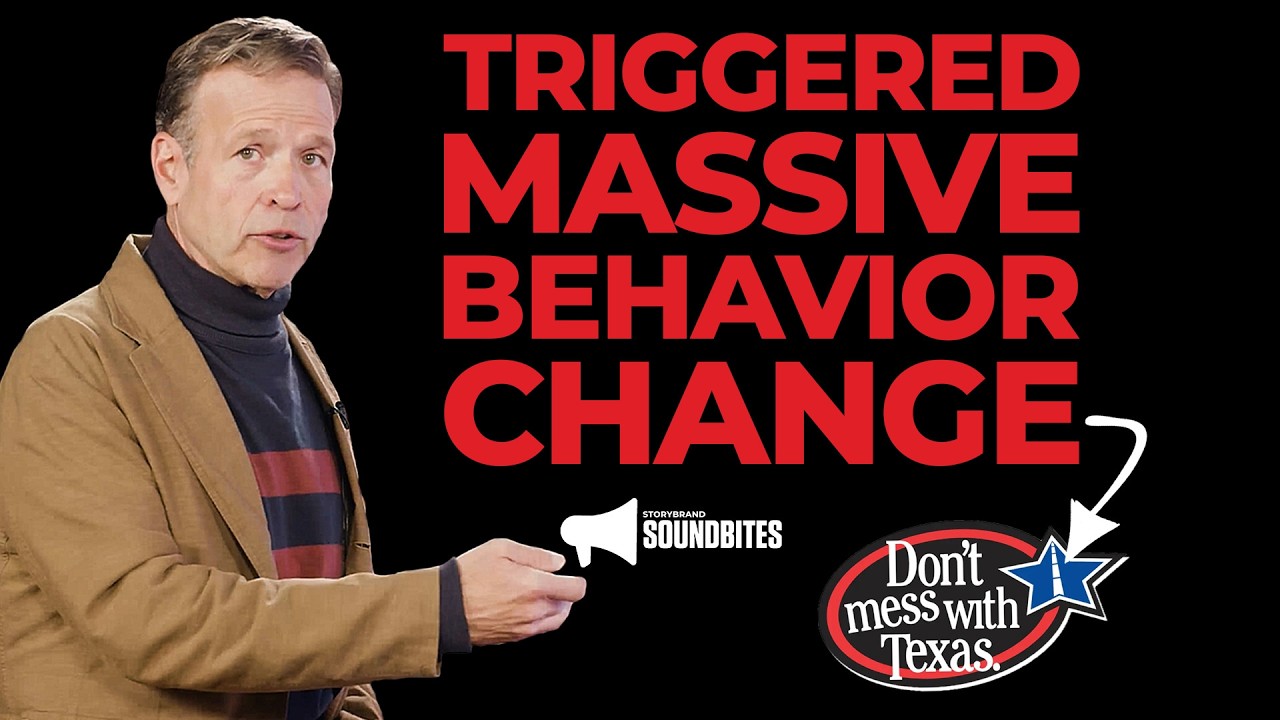
How These 4 Words Drove Massive Behavior Change
StoryBrand With Donald Miller
Transform behavior by framing actions as expressions of identity and community pride, like 'Don't Mess with Texas'.
Executive Summary
In the video "How These 4 Words Drove Massive Behavior Change," the speaker analyzes the success of the Texas Department of Transportation's "Don't Mess with Texas" campaign, which reframed littering as an affront to Texas pride and identity. By positioning litterers as outsiders and leveraging community loyalty, the campaign significantly reduced littering through a clear, bold message that resonated with Texans. The speaker outlines key strategies for creating effective messaging campaigns, emphasizing the importance of identity, community belonging, and low cognitive load to drive behavior change.
Key Takeaways
- Define your brand's core belief to create a sense of identity among your audience.
- Develop a clear and memorable slogan that resonates with your community's values.
- Identify and position a 'villain' to clarify your brand's mission and create a sense of unity.
- Engage your audience through community events that promote ownership and pride in your message.
- Utilize user-generated content and testimonials to celebrate community members and strengthen tribal loyalty.
Key Insights
- The Don't Mess with Texas campaign reframed littering as an act against Texan identity, transforming a behavioral issue into a matter of community pride and belonging.
- By positioning litterers as outsiders, the campaign effectively created a sense of tribal loyalty, encouraging Texans to adopt litter-free behaviors as a badge of honor.
- The campaign's success illustrates that clear, bold messaging rooted in shared identity can significantly lower cognitive load, making it easier for individuals to embrace and spread the message.
- Identity-driven campaigns, like Don't Mess with Texas, show that tying actions to community belonging can lead to more profound and lasting behavior changes than traditional persuasive tactics.
- The strategic use of sound bites in messaging campaigns highlights the importance of simplicity and emotional resonance, ensuring that the message is memorable and impactful.
Summary Points
- The 'Don't Mess with Texas' campaign reframed littering as a threat to Texas identity and pride.
- Successful messaging campaigns should focus on community identity and tribal belonging to drive behavior change.
- Clear, bold sound bites with low cognitive load enhance message retention and sharing among audiences.
- Engaging the community through events and incentives fosters ownership and loyalty to the campaign's message.
- Identifying insiders and outsiders helps clarify group identity and motivates individuals to adopt desired behaviors.
Detailed Summary
- The video discusses the transformative 'Don't Mess with Texas' campaign, which effectively reduced littering by appealing to Texans' sense of identity, community pride, and tribal belonging rather than simply promoting anti-littering messages.
- The campaign emerged in response to a significant litter problem in Texas during the late 1970s and early 1980s, where traditional messages failed to resonate with the target audience, primarily young male drivers.
- GSD&M, the agency behind the campaign, identified that Texans respond better to messages that invoke pride and toughness, leading to the creation of the iconic phrase 'Don't Mess with Texas' as a declaration of community loyalty.
- The sound bite 'Don't Mess with Texas' reframed littering as an act committed by outsiders, thus fostering a sense of belonging among Texans and transforming littering into a behavior that threatened their identity.
- The video outlines a three-phase messaging campaign structure: curiosity, enlightenment, and commitment, emphasizing the importance of creating sound bites that attract attention and resonate with the audience's identity.
- Key strategies for the campaign included celebrity involvement, community clean-up events, and the distribution of branded merchandise, which helped to reinforce the message and encourage public participation in the anti-littering effort.
- The speaker highlights the importance of defining insiders and outsiders in a campaign, as well as creating a tribal identity that fosters loyalty and encourages individuals to adopt behaviors aligned with that identity.
- Finally, the video encourages viewers to create their own messaging campaigns by following four steps: defining core beliefs, giving the tribe a badge of honor, identifying a villain, and celebrating community members publicly.
What was the primary issue addressed by the 'Don't Mess with Texas' campaign?
According to the video, what demographic was identified as the primary litterers in Texas?
What was the key message of the 'Don't Mess with Texas' campaign?
What strategy did the campaign use to change the perception of littering?
What are the three phases of a messaging campaign mentioned in the video?
Which of the following was NOT mentioned as a method used in the campaign?
What does the speaker suggest is crucial for a successful messaging campaign?
What is one of the lessons learned from the 'Don't Mess with Texas' campaign?
How did the campaign transform the identity of Texans?
What role did incentives play in the 'Don't Mess with Texas' campaign?
What was the main issue Texas faced before the campaign?
Texas had a significant litter problem in the early '80s, with people frequently throwing trash out of their vehicles. This led to tens of millions spent annually on cleaning highways.
What was the breakthrough sound bite of the Texas anti-litter campaign?
The breakthrough sound bite was 'Don't Mess with Texas.' This phrase reframed littering as an act against Texas pride, making it a declaration of community loyalty rather than a simple anti-litter message.
How did the campaign change perceptions of littering?
The campaign positioned litterers as outsiders who disrespected Texas. Not littering became a way to protect the state's identity and pride, fostering a sense of belonging among Texans.
What are the three phases of a messaging campaign?
The three phases are curiosity, enlightenment, and commitment. Curiosity attracts attention, enlightenment provides information, and commitment encourages action towards the desired behavior.
Why did traditional anti-litter messages fail?
Traditional messages like 'Please don't litter' failed because they were perceived as condescending and did not resonate with Texans' identity or cultural values.
What role does identity play in behavior change according to the video?
Identity drives behavior change by linking actions to a sense of belonging. When people feel that an action aligns with their identity, they are more likely to adopt it.
What is a key strategy for creating a successful sound bite?
A successful sound bite should be clear, bold, and rooted in a shared identity. It must resonate emotionally and be easily repeatable to encourage word-of-mouth spread.
What is the significance of defining insiders and outsiders in a campaign?
Defining insiders and outsiders clarifies group identity and strengthens community bonds. It helps create a sense of belonging among supporters while positioning detractors as threats.
How did Texas leverage community involvement in the campaign?
Texas involved citizens through community clean-up events, which fostered ownership of the campaign and reinforced the identity of being a proud Texan.
What are the five foundational sound bites mentioned in the campaign?
The five foundational sound bites are: 1) Texas highways are being trashed (problem), 2) We know you want to protect Texas (empathy), 3) Demonstrate Texas pride (answer), 4) Stop littering (change), 5) Clean Texas highways (end result).
What is the purpose of a 'badge of honor' in a messaging campaign?
A badge of honor, such as a slogan or symbol, signifies membership in a community. It fosters pride and reinforces the identity associated with the campaign.
What is the importance of low cognitive load in messaging?
Low cognitive load means that the message is easy to understand and remember. This increases the likelihood that people will engage with the message and take action.
How can brands create a tribal identity?
Brands can create a tribal identity by defining core beliefs, giving the tribe a badge of honor, identifying a villain, and celebrating community members publicly.
What was the long-term impact of the 'Don't Mess with Texas' campaign?
The campaign not only reduced litter but also became a cultural icon, reinforcing Texas pride and identity, and is still recognized decades later.
What are some methods used to promote the 'Don't Mess with Texas' campaign?
Methods included celebrity involvement, community events, promotional swag like stickers and shirts, and incentives for participation, all aimed at fostering community pride and ownership.
Study Notes
The video begins by introducing the concept of sound bite strategies, emphasizing their effectiveness in communication. The speaker shares a personal anecdote about growing up in Texas, where littering was rampant. He highlights the transformation brought about by a specific campaign aimed at reducing litter. The goal of the video is to teach viewers how to create viral messages, particularly through the lens of the Texas Department of Transportation's campaign against littering. This sets the stage for understanding the importance of identity and community in messaging.
The speaker outlines the litter problem in Texas during the late 1970s and early 1980s, noting that tens of millions were spent annually on cleanup efforts. Young male drivers aged 18 to 35 were identified as the primary offenders. Traditional messaging, such as polite requests not to litter, failed to resonate with this demographic. The speaker emphasizes that the issue was not just behavioral but deeply rooted in cultural identity, which required a different approach to effectively address the problem.
A pivotal moment in the campaign occurred when the agency GSD&M recognized that the issue of littering was tied to identity rather than mere behavior. They proposed that Texans respond better to messages that evoke pride and toughness. The breakthrough came with the phrase "Don't Mess with Texas," which reframed littering as an affront to Texas pride. This message positioned litterers as outsiders, thereby fostering a sense of community among Texans who took pride in their state and its cleanliness.
The success of the "Don't Mess with Texas" campaign can be attributed to several key elements. The message was clear, bold, and easily repeatable. It was rooted in a shared identity, emphasizing community pride rather than attempting to change behavior directly. The campaign effectively positioned litterers as non-Texans, reinforcing the idea that not littering was a badge of honor among Texans. This created a strong emotional connection to the message, leading to widespread acceptance and participation in the campaign.
The speaker outlines a three-phase structure for effective messaging campaigns: curiosity, enlightenment, and commitment. Curiosity sound bites attract attention, while enlightenment collateral provides more information. Commitment collateral encourages individuals to take action, such as pledging to stop littering. The speaker compares the messaging campaign to a house, emphasizing the importance of having a welcoming front and clear steps that guide individuals through the process of engagement with the message.
The speaker introduces five foundational sound bites that can serve as the basis for a messaging campaign. These include: 1) Problem sound bite: "Texas highways are being trashed"; 2) Empathy sound bite: "We know you want to protect Texas"; 3) Answer sound bite: "Demonstrate Texas pride"; 4) Change sound bite: "Stop littering"; 5) End result sound bite: "Clean Texas highways we can be proud of." Each sound bite serves a specific purpose in attracting attention, creating empathy, and motivating action.
The campaign's success was further enhanced by community engagement strategies. The state of Texas involved citizens in cleanup events, fostering a sense of ownership over the campaign. This participation not only reinforced the message but also allowed individuals to feel like proud Texans defending their state. The use of merchandise, such as stickers and shirts, transformed the sound bite into a badge of honor, further solidifying the campaign's impact and reach within the community.
The speaker concludes with several key lessons for creating effective messaging campaigns. These include selling community and tribal identity, defining insiders and outsiders, and celebrating community members publicly. By tying actions to a sense of belonging, campaigns can drive behavior change more effectively. The speaker emphasizes the importance of clarity in messaging and the need to create a strong tribal identity that resonates with the audience, ultimately leading to greater loyalty and engagement.
In the closing segment, the speaker encourages viewers to explore additional resources for developing their messaging strategies, such as the StoryBrand SoundBite Strategy course and workshops. He reiterates the importance of clarity in messaging and how a well-structured sound bite strategy can significantly enhance the effectiveness of communication efforts. The video wraps up with a call to action for viewers to implement the strategies discussed and to avoid confusion in their messaging.
Key Terms & Definitions
Transcript
This is one of the most effective sound bite strategies of all time. In fact, I am a native Texan. I grew up in Texas. I remember as a kid the roads being filled with litter. I mean, it's hard to imagine today, but you would drive down the road in Texas and there would just be trash everywhere. And it was this campaign that stopped that in its tracks. By the end of this video, I'm going to help you understand how to make a message go viral. >> [applause] >> Hey everybody, thanks for joining us for the weekly sound bite video. Each week we break down a real-world messaging strategy that has worked incredibly well. And the idea, of course, is to transform you into a sound bite specialist. Today's video is all about how the Texas Department of Transportation created an iconic campaign that used identity, community, and tribal belonging to reduce litter. By the end of this video, I'm going to help you understand how to make a message go viral. How do you actually get people talking about your message? Show you a three-step process to build a passionate tribe, which was key in the Don't Mess with Texas campaign, build a brand by creating a villain, yet another tip. Before we get there though, there are several ways that you can create your sound bite strategy campaign. You can get the StoryBrand sound bite strategy on-demand course. You can attend the StoryBrand Your Business Live Workshop in Nashville, Tennessee, which is a lot of fun. You can book a StoryBrand private workshop where we send a facilitator to you. Or you can work with one of our StoryBrand certified guides to do your entire campaign for you. Our guides are are certified to do that. I trained them myself and they're at marketingmadesimple.com. Any of that other stuff, just go to storybrand.com and you can find out more. All right, this was the problem. This is what Texas looked like before the campaign. Texas had a major litter problem throughout the early '80s. So, all the way into the late '70s, early '80s, people just threw their trash out the window. Tens of millions were spent annually cleaning highways. Young male drivers, uh-oh, 18 to 35 produced the most litter. I'll confess to nothing on that. But, be polite, please don't litter. That kind of messaging had zero impact. Nobody paid attention to it. And the problem wasn't behavioral, it was cultural. So, then came along a turning point. Something changed. The agency GSD&M proposed the issue wasn't about trash, it was about identity. Texans don't respond to gentle rules. Texans do not respond. And as a native Texan, I'm telling you, it just doesn't work. You got to You got to come out tough. Texans respond to pride, toughness, and community loyalty. The question became, what identity would make not littering feel like being a true Texan? That was the idea that GSD&M came up with. And the breakthrough sound bite was this, Don't Mess with Texas. The controlling idea, Don't Mess with Texas. Not Don't Litter, cuz that sounds condescending. It was Don't Mess with Texas. By the way, this was never a phrase about politeness. It was a declaration of community pride and tribal belonging. It reframed littering as something done by outsiders, people who don't respect Texans. And I remember when this campaign launched, I remember me and my friends were litterers and we literally all of a sudden thought of litterers as somebody who was messing with us and our state. Not littering became a way to protect the tribe. So, just a few words, four words, launched an entire state identity and cleaned up the streets of Texas. Really kind of amazing. So, why did the sound bite work? One, clear, bold, and repeatable. Also, rooted in a shared identity, not trying to change behavior. Trying to enforce, enhance, empower, if you will, an identity. Unified Texans around community pride. Texans are very, very proud people. It's a great state and they they united around that idea. This one is really important. Position litterers as non-Texans. Even though they lived in Texas, they weren't like us. They were people outside the proud, disciplined, uh tough tribe. Turned picking up after yourself into a badge of Texas loyalty. And by the way, it just created a brand. You see Don't Mess with Texas everywhere. That Texas pride. The great thing about this campaign is nobody was confused about it. You read Don't Mess with Texas and you you felt, and this is really important about the sound bite, you felt something. You felt a sense of pride, toughness, togetherness, belonging. And can I just say it? You felt superior. You felt superior to other states. Texans love feeling superior and they would argue it's because they are superior. The confused mind always says no. If people can't figure out what identity you can help them achieve within seconds, word is unlikely to spread about your campaign and people are not going to take it seriously. The problem with most public service campaigns, and most of them fail, they're wastes of money, is the cognitive load of your message is just too high. Most businesses are too vague in their offering. Therefore, the cognitive load involved in understanding why to buy their product is causing customers to look elsewhere. The bottom line is the lower the cognitive load, the more people place orders, the more you change behavior. Don't Mess with Texas equals low cognitive load. All right, your messaging campaign is built on sound bites, but it's got to have three phases, as you know, the curiosity phase, enlightenment, and commitment. That means you need curiosity sound bites. Don't Mess with Texas will be one of those, but there's four more that I want to give you here in a second. And then you need enlightenment collateral, and then you need commitment collateral. You need rewards for actually going through with the behavior. These three things need to be checked off in a messaging campaign. I'm going to show you the entire campaign, or a snapshot of the campaign, here in a second. Your messaging needs to work like a house. There's front steps. These are the introductory ideas that bring attention to your brand. I've got five sound bites I'll share with you. Then the front porch, which is where people stand to do due diligence and find out more about it, get comfortable with the idea. And then there's the front door that you go through, and that is the commitment phase where I'm going to stop littering or I'm going to volunteer, whatever. Those three phases are critical if you want to run a really great messaging campaign. Most messaging campaigns look like this. The house is boarded up. There's no front steps. This is not a warm and inviting house. The foundational, most important part of the campaign are the sound bites that are those front steps. Those sound bites need to be a problem sound bite, and the purpose of the problem sound bite is to attract attention. The empathy sound bite, the purpose of the empathy sound bite is to create an empathetic bond. The answer sound bite, the purpose of the answer sound bite is to elevate the value of the product or idea. The purpose of the change sound bite is to add personal value to the offer. And the end result sound bite is to give them a vision that motivates direction and action. Let's look at an entire StoryBrand sound bite strategy messaging campaign in hindsight, reverse engineering what it is that the Don't Mess with Texas campaign did and why it worked. All right, let's look at those first five sound bites, that foundational front steps. Texas highways are being trashed. That's the problem. And notice, even though it's Texans who are doing this, they are positioned as outsiders, those litterers. They're not like us. Empathy, we know you want to protect and defend Texas. Answer, demonstrate Texas pride. Don't mess with mess with Texas. Stop littering. That's the behavior that we want to change. The change, the transformation of the person who adopts this message, is proud, strong, and litter-free Texan. The end result, clean Texas highways that we can be proud of. This would be the five sound bites that we might use as a foundation as foundational ideas behind this messaging campaign. Now, that's just the beginning. Once you have those five sound bites, and by the way, there are rules on each of these sound bites. Go inside the course and understand the rules on the problem, empathy, answer, change, and end result sound bite if you want to understand the rules behind creating them so you can create your own. Then, once we have those sound bites, we need to use them in an actual campaign. So, you know, there's millions of options here on the front porch. Here's some things that that Texas did. Celebrity involvement. Texas leveraged Texans with influence to boost the campaign. Community clean-up events. The state of Texas got citizens involved and shared ownership of the campaign. This was critical. I remember going out and picking up litter and being a proud Texan and thinking, what are these non-Texans doing throwing these Coke cans and beer cans out on the side of the road? Swag. Stickers, shirts, hats, and posters turned the sound bite into a badge of honor and a tribal flag. I would guess that the Don't Mess with Texas campaign is actually a profitable campaign. And think about that. Instead of spending money to reduce litter, spending money on a public service campaign, you're making money because the tagline is so popular. Why is it so popular? It all goes back to that identity. And then there are incentives to actually agree with the campaign. The campaign attempted to transform the identity of every Texan by getting them to agree with the idea. If you agree with this idea, you are a proud, strong Texan and you defend your home. Join the effort. Opportunities to volunteer gave hundreds of thousands of Texans a sense of ownership and reinforced the tribal identity. Share the message. Wearing the swag and flying the flag rewarded those who shared the message with a sense of pride and a strong, tough, responsible tribal identity. All right, let me go through some of the lessons that you can learn and you can implement in your campaign. First, sell community. Have you thought about that in your campaign? Have you thought about selling a tribal identity? What is the tribal identity? People want to belong to something bigger than themselves. Texas sold membership in a proud community. The price of membership was don't litter and agree with us and defend your state. Here's a very good tip. Now, there's thousands of ways you can create a messaging campaign. I'm going to give you a few tips that the state of Texas used. Define insiders and outsiders. Who are we and who are they? And who are we going to stop and why are we better than them? And why are we uh against what they're doing? There is an an an innate need in human beings, especially men, cuz you know, remember 18 to 35-year-old men were the ones doing the most of the littering. So, there's this need to defend and protect. It's a biological response and they triggered that. They stimulated that in this campaign. This is not divisive. It's a clarifying way of saying, "This is who we are. We are people who don't litter and outsiders who are not like us and are very clear that they litter." Brands must say, "People who aren't like us are a threat to our identity." Who isn't like you and who is a threat to your tribe's identity? Three, a tribe is a shortcut to loyalty. You want to create a tribe around your brand. Seth Godin defines a tribe as, "We are people who believe or do X. We are people who believe or do X." Texas created a tribe of people who don't mess with Texas. Also, tip number four, identity drives behavior. When you tie an action to belonging, people adopt it more quickly. So, the four steps to building a tribal identity around your brand. First, define your tribe's core belief. What is the we are people who believe X statement for you? Just write that down right now. We are people who believe X. What is X for your brand? Example, we are people who protect Texas. Step two, give the tribe a badge of honor, a slogan, behavior, or symbol that says, "I'm one of us." Texas used the phrase on bumper stickers and shirts to great success. It is still these gosh, what, 30, 40 years later, you see don't mess with Texas everywhere. Step three, identify the villain. It's really critical. If you can have a villain, make a villain. These are This is what we are against. Are litterers villains? Yeah, they're villains. Yeah, so it's okay if they're actual villain. It's not a person usually. It's a behavior or threat. Texas made littering the outsider behavior, not like us. Step four, celebrate the members of your community publicly. Feature stories, testimonials, user-generated content, ambassadors, influencers who are like us. When people feel seen, the tribe grows. All right, how can you actually create a messaging campaign of your own? Get the StoryBrand SoundBite Strategy on-demand course. Attend the StoryBrand Your Business Live Workshop in Nashville. We'd love to see you in person. Book a StoryBrand private workshop where we send a facilitator to you. Or just hire one of our certified guides to create your entire messaging campaign for you. You can find them at marketingmadesimple.com. If you want to learn more, go to storybrand.com. Confusion will not grow your brand. A soundbite strategy will work. Let us help you create your entire messaging campaign at storybrand.com. All right, thanks again. We'll see you next week. >> Yeah.
Title Analysis
The title 'How These 4 Words Drove Massive Behavior Change' contains some attention-grabbing elements but is not overly sensational. It does not use ALL CAPS, excessive punctuation, or exaggeration. The phrase 'massive behavior change' may create curiosity but remains relevant to the content discussed, which focuses on the effectiveness of a specific campaign. Overall, it is straightforward and accurately reflects the video's theme.
The title closely aligns with the video's content, which explains how the phrase 'Don't Mess with Texas' effectively changed littering behavior in Texas. While it emphasizes '4 words,' the content elaborates on the broader strategy behind the campaign. There are no significant discrepancies between the title's promise and the actual delivery, making it a strong representation of the video's focus.
Content Efficiency
The video has a high information density, with approximately 75% of the content delivering unique and valuable insights into effective messaging strategies. While there are some repetitive phrases, particularly around the campaign's core message 'Don't Mess with Texas,' the majority of the content provides actionable advice and historical context. The speaker effectively conveys the importance of identity and community in messaging, but some anecdotes and personal reflections could be considered filler.
The pacing of the video is generally effective, with a clear structure that guides the viewer through the messaging strategy. However, there are moments of unnecessary elaboration, particularly in personal anecdotes that could be shortened without losing impact. The overall flow is good, but tightening some sections could enhance the overall efficiency, making it more concise while retaining key points.
Improvement Suggestions
To improve information density and time efficiency, the speaker could reduce the length of personal anecdotes and focus more on delivering core insights succinctly. Additionally, minimizing repetition of key phrases and summarizing points more quickly would help maintain viewer engagement. Incorporating visual aids or bullet points could also enhance clarity and retention of information, allowing for a more streamlined presentation.
Content Level & Clarity
The content is rated at an intermediate level (5) because it assumes some foundational knowledge of marketing concepts and behavioral psychology. While it introduces specific strategies and examples, a complete beginner may struggle to grasp the nuances of identity-driven messaging without prior exposure to marketing principles or campaign strategies.
The teaching clarity score is 8, indicating that the content is mostly clear and well-structured. The speaker effectively uses real-world examples, such as the 'Don't Mess with Texas' campaign, to illustrate key points. The logical flow is maintained through a clear progression of ideas, although some sections could benefit from more concise explanations to enhance understanding.
Prerequisites
A basic understanding of marketing principles, messaging strategies, and behavioral psychology would be beneficial for fully grasping the content.
Suggestions to Improve Clarity
To improve clarity, the speaker could incorporate more visual aids or summaries at the end of each section to reinforce key points. Additionally, breaking down complex concepts into simpler terms or providing definitions for marketing jargon would help make the content more accessible to a wider audience. Finally, including interactive elements or questions for reflection could engage viewers and enhance retention.
Educational Value
The content presents a compelling case study on the 'Don't Mess with Texas' campaign, effectively illustrating how messaging can drive behavioral change through identity and community pride. It provides factual information about the campaign's background, target demographics, and the psychological principles behind its success. The teaching methodology is engaging, using storytelling and real-world examples to enhance understanding. The depth of content is significant, covering the cognitive load concept and the importance of sound bites in messaging. Knowledge retention is likely high due to the relatable anecdotes and practical strategies presented, such as the three phases of a messaging campaign. Overall, the content facilitates learning by offering actionable insights that can be applied in various marketing contexts.
Target Audience
Content Type Analysis
Content Type
Format Improvement Suggestions
- Incorporate visual aids to illustrate key points
- Add on-screen text for important sound bites
- Include real-life examples or testimonials from participants
- Use engaging graphics to represent statistics
- Break the content into shorter segments for better retention
Language & Readability
Original Language
EnglishModerate readability. May contain some technical terms or complex sentences.
Content Longevity
Timeless Factors
- Universal themes of community and identity that resonate across cultures and time periods.
- Fundamental principles of effective messaging and behavior change that apply to various contexts.
- The concept of tribal belonging, which is a timeless aspect of human psychology.
- The effectiveness of sound bites in communication, which remains relevant in marketing and public campaigns.
- The historical context of the campaign provides a case study that can be referenced in future discussions about behavior change.
Occasional updates recommended to maintain relevance.
Update Suggestions
- Incorporate recent statistics on littering and environmental awareness to provide current context.
- Reference contemporary examples of similar successful campaigns to illustrate ongoing relevance.
- Update any outdated terminology or phrases to ensure clarity and relatability for new audiences.
- Add insights from recent studies on behavior change and messaging strategies to enhance the content's depth.
- Include feedback or results from the campaign's long-term impact to provide a comprehensive view.