
 10:30
10:30
Skills I'm Learning In 2026
Tina Huang
Master personal finance, diversify investments, and embrace AI to thrive in 2026's evolving economy.
Executive Summary
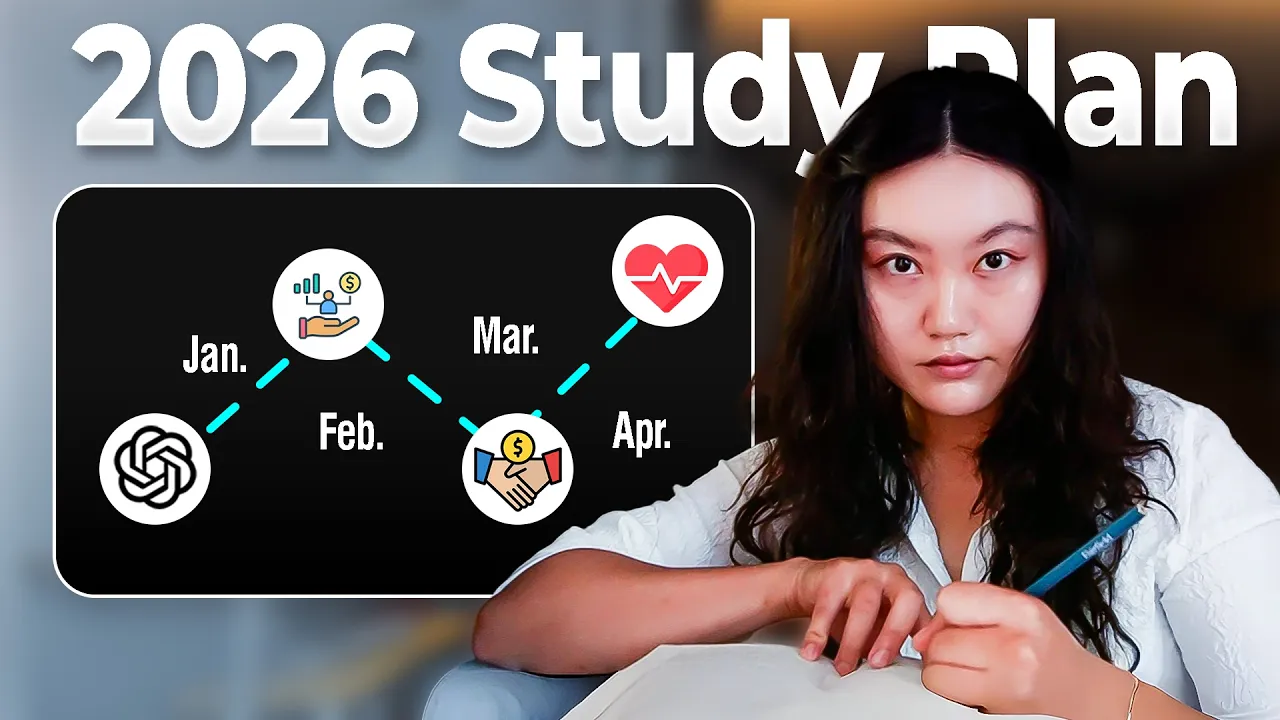
In the video "Skills I'm Learning In 2026," Tina emphasizes the importance of continuous learning, particularly in personal finance, AI, and business skills. She identifies key areas for development, including financial literacy, building an emergency fund, diversifying investments, and creating multiple income streams to navigate economic uncertainties. Additionally, she highlights the growing opportunities in AI and the significance of understanding business operations for aspiring entrepreneurs, encouraging viewers to leverage available resources for their personal and professional growth.
Key Takeaways
- Learn basic financial literacy by researching budgeting, credit, insurance, and taxes through online courses like Khan Academy's financial literacy course.
- Build an emergency fund covering 3 to 6 months of living expenses to prepare for unexpected financial situations.
- Diversify your investment portfolio beyond AI stocks and the S&P 500 by exploring global markets and different sectors.
- Explore freelancing or starting a side business to create multiple income streams, leveraging platforms like Upwork or Fiverr to get started.
- Utilize AI tools to streamline product development and business operations, following guides like HubSpot's 'Seven AI Tools Every Founder Needs in 2026.'
- Invest time in learning business fundamentals to transition from a hobbyist to a sustainable business owner, using resources like books and online courses.
Key Insights
- The necessity of personal finance education highlights a systemic gap in traditional schooling, emphasizing the importance of self-directed learning for financial literacy and stability.
- Diversifying income streams is not just a strategy for wealth building but a critical safeguard against economic uncertainty, reflecting a shift in how individuals approach financial security.
- AI's rapid evolution democratizes software development, enabling anyone with an idea to create and launch products, thus reshaping entrepreneurial landscapes and reducing barriers to entry.
- The distinction between linear career growth and the exponential potential of business ownership reveals the unique challenges and rewards of entrepreneurship, encouraging a mindset shift for aspiring business owners.
- Learning about business operations is essential for scaling and sustainability, showcasing the importance of continuous education and adaptation in a fast-paced economic environment.
Summary Points
- Learn personal finance skills, including budgeting, credit, insurance, and investing for economic stability.
- Build an emergency fund to cover 3-6 months of living expenses for unexpected situations.
- Focus on diversifying investments beyond AI stocks for better financial security.
- Explore AI opportunities for creating software and integrating AI into businesses.
- Understand business fundamentals to transition hobbies into sustainable income-generating ventures.
Detailed Summary
- The video emphasizes the importance of continuous learning in a rapidly changing world, highlighting personal finances and investing as crucial skills to acquire by 2026, especially amid economic instability and the rise of AI.
- Tina introduces herself as a YouTuber and entrepreneur with a background in data science, sharing her passion for learning and the goal of helping viewers navigate essential skills for the future.
- Basic financial literacy is identified as a foundational skill, covering budgeting, credit, insurance, taxes, and investing, with a recommendation to learn through resources like Khan Academy's financial literacy course.
- The necessity of an emergency fund is discussed, suggesting that viewers should save 3 to 6 months' worth of living expenses to prepare for unforeseen circumstances, whether positive or negative.
- Tina stresses the importance of diversifying investments, noting that AI stocks dominate the S&P 500, and encourages viewers to explore global investment opportunities and multiple income streams to mitigate risks.
- The video transitions to the significance of learning AI, highlighting the accessibility of software development without coding knowledge and the growing demand for AI integration in businesses, supported by a McKenzie study.
- Tina shares insights on entrepreneurship, explaining how business ownership can reduce tax burdens and emphasizing the nonlinear growth potential of businesses compared to traditional employment.
- The video concludes with a call to action for viewers to engage in learning these skills and share their experiences, reinforcing the theme of empowerment through knowledge in 2026.
What is the first important skill Tina suggests learning in 2026?
According to Tina, what is an emergency fund?
What percentage of the S&P 500 market capitalization do AI stocks account for, according to Tina?
What does Tina suggest is a good strategy for investing in 2026?
What is one benefit of owning a business that Tina mentions?
What does Tina mean by 'lifestyle business'?
What does Tina believe is essential for anyone wanting to build software products?
What is the main theme of the video?
What is the first important skill to learn in 2026?
Personal finances and investing are crucial skills for 2026 due to economic changes, potential layoffs, and AI impacts. Understanding these concepts helps capture opportunities and hedge against instability.
What are the four key areas of personal finance to learn?
The four key areas include: 1) Basic financial literacy (budgeting, credit, taxes), 2) Emergency funds (3-6 months of living expenses), 3) Investing (diversifying investments), and 4) Creating multiple income streams.
Why is financial literacy important?
Financial literacy empowers individuals to manage their money effectively, set financial goals, and make informed investment decisions. It provides the confidence to explore other interests, such as AI and entrepreneurship.
What is an emergency fund?
An emergency fund is a savings reserve set aside for unexpected expenses, such as job loss or urgent financial needs. It is recommended to save 3 to 6 months' worth of living expenses.
How has AI changed opportunities for creators?
AI has democratized software development, allowing anyone to build products without extensive coding knowledge. Companies are increasingly integrating AI into workflows, creating new job opportunities in freelancing and entrepreneurship.
What are the two major takeaways about AI for 2026?
1) Anyone can build software products easily and affordably, and 2) Companies are focusing on integrating AI into their operations, indicating a growing demand for AI-related skills.
What is the significance of diversifying income streams?
Diversifying income streams mitigates financial risk during economic instability. With more opportunities for freelancing and side gigs, individuals can create additional revenue sources to enhance financial security.
What is the difference between a full-time job and owning a business?
A full-time job typically offers linear growth in income and satisfaction based on time and effort. In contrast, a business can have exponential growth, often requiring initial hard work before seeing significant returns.
What are the tax benefits of owning a business?
Owning a business can significantly reduce tax liabilities compared to traditional employment. Business owners often have access to deductions and credits that lower their overall taxable income.
What should aspiring business owners focus on?
Aspiring business owners should learn how to operationalize their business, scale effectively, and hire the right talent. Understanding these aspects is crucial for long-term success and sustainability.
What resources can help with starting a business in 2026?
Resources like HubSpot's guide on AI tools for founders provide step-by-step instructions for launching a product, hiring employees, and preparing for funding, making the entrepreneurial process more manageable.
What is a lifestyle business?
A lifestyle business is designed to maximize personal freedom and satisfaction rather than focusing on rapid growth or high revenue. It allows owners to work on projects they are passionate about.
How can learning about business change a hobby into a profitable venture?
Understanding business principles helps individuals transform hobbies into sustainable income sources by applying strategies for marketing, sales, and operations, thus monetizing their passions effectively.
What is the role of AI in business integration?
AI plays a crucial role in enhancing business efficiency by automating processes, improving decision-making, and enabling data-driven strategies. Companies are increasingly looking for ways to incorporate AI into their daily operations.
Study Notes
In the opening of the video, Tina expresses her passion for learning and emphasizes the importance of continuous education in a rapidly changing world. She introduces herself as a YouTuber and entrepreneur with a background as a data scientist at Meta. Tina sets the stage for discussing essential skills to learn in 2026, highlighting the need for adaptability in the face of economic changes and advancements in technology. This introduction serves to engage viewers and prepare them for the insights she will share throughout the video.
Tina identifies personal finance and investing as the first critical skill to learn in 2026. She notes the current economic climate, including potential layoffs and the impact of AI, as reasons to enhance financial knowledge. Tina emphasizes that understanding personal finances can help individuals seize opportunities and protect themselves against financial instability. She encourages viewers to take financial literacy seriously, as it is often not taught in schools, and stresses the importance of being proactive in learning these skills.
Under the personal finance umbrella, Tina discusses the necessity of basic financial literacy. She outlines key components such as budgeting, setting financial goals, understanding credit, insurance, taxes, and investing. Tina shares her own experience of having to learn these concepts independently, highlighting the lack of formal education on financial topics. She also recommends a financial literacy course from Khan Academy as a valuable resource for viewers looking to build their foundational knowledge in finance.
Tina emphasizes the importance of having an emergency fund, which is cash set aside for unexpected situations, whether they are positive or negative. She advises viewers to save enough to cover three to six months of living expenses, providing a safety net in case of job loss or other financial emergencies. This concept is crucial for financial stability and is a fundamental aspect of personal finance that everyone should prioritize. Tina encourages viewers to start building their emergency funds as a first step in their financial journey.
Moving on to investing, Tina discusses the significance of diversifying investments to maintain financial stability and build wealth. She notes the current dominance of AI stocks in the S&P 500 and warns that relying solely on this index may not provide adequate diversification. Tina shares her personal strategy of looking beyond traditional investments and exploring global opportunities across various sectors. This insight is vital for viewers who want to enhance their investment strategies in a changing market.
Tina highlights the importance of diversifying income streams as a strategy to mitigate economic instability. She encourages viewers to consider freelancing, starting side gigs, or launching their own businesses, as these options have become more accessible. By creating multiple sources of income, individuals can better protect themselves against financial downturns. Tina promises to provide more detailed advice on this topic later in the video, making it a key point for viewers to consider in their financial planning.
Tina transitions to discussing the growing field of artificial intelligence (AI) and the opportunities it presents. She notes that anyone interested in building software products can now do so without extensive coding knowledge, thanks to advancements in AI technology. Tina emphasizes that businesses are increasingly looking to integrate AI into their workflows, creating a demand for skills in this area. This section is crucial for viewers who want to stay relevant in the job market and explore new career paths in AI.
In the latter part of the video, Tina discusses the importance of learning business skills, especially for those interested in entrepreneurship. She shares her personal experience of transitioning from a full-time job to running her own lifestyle business, highlighting the tax advantages and the different mindset required for business ownership. Tina encourages viewers to educate themselves on business operations, scaling, and hiring, providing valuable insights for aspiring entrepreneurs looking to turn their passions into sustainable ventures.
Tina concludes by recommending various resources for viewers interested in learning more about financial literacy, AI, and business. She mentions a free guide from HubSpot that outlines essential AI tools for founders, which can help streamline the process of launching a product. By providing these resources, Tina aims to empower viewers to take actionable steps towards their learning and entrepreneurial goals, reinforcing the video’s theme of continuous growth and exploration in 2026.
In the final moments of the video, Tina encourages viewers to share their own learning journeys and the skills they are pursuing. She expresses her curiosity about the diverse interests of her audience and invites them to engage in the comments section. This closing remark fosters a sense of community and encourages viewers to reflect on their personal growth, reinforcing the overall message of the video about the importance of lifelong learning and adaptation in a rapidly changing world.
Key Terms & Definitions
Transcript
Learning is literally my favorite thing in the world, especially these days with the speed of the world progressing at a dizzyingly fast rate. The future belongs to those who do not stop learning. So, in this video, I want to share with you guys some of the most important skills to learn in 2026, in my opinion, which of course I'm also going to be personally [music] learning. A portion of this video is sponsored by HubSpot. Oh, by the way, I think a lot of you guys are new here, so I just wanted to give a quick little introduction of myself. Hello, my name is Tina. I am a YouTuber and entrepreneur, and in my past life, I was a data scientist at Meta. And yeah, like I said previously, I really like learning things. Welcome to this channel. All right, let's go. [music] The first important skill to learn in 2026, in my opinion, is personal finances and investing. Going to 2026, I think there's a lot of talks about economic changes, things about like potentially layoffs, of course, the impact of AI, and just general market instability, which for me are signals to focus on learning more about personal finances and investing to be able to capture opportunities that are going to be available and also to hedge myself in case things don't go so well. There are four things under this personal finances/investing category that I think is important to learn. Disclaimer, I'm not a financial adviser, not even like a finance expert, really just like an internet person also trying to learn things. So, please take what I say with a grain of salt. Just wanted to share in case it's useful. Okay. The first thing that I think everybody should learn is basic financial literacy. Like, it is crazy to me that the majority of people do not have basic financial literacy cuz it's just not taught in school. Like, nobody taught me about financial literacy in school either. I had to go learn it myself. stuff like budgeting, how to even set financial goals, credit, [music] insurance, taxes, investing. Yeah, if you're also kind of fuzzy on these topics, really recommend that you learn these things. I did make a video which I'll link over here, which summarizes Khan Academyy's 20our plus financial literacy course, which I think gives you the basis. In that course, they also cover the very important concept called an emergency fund, which is the second thing that I think everybody should learn and be aware of. An emergency fund is cash that you set aside just in case something happens and you need to use that money. could be something [music] bad that happens. Knock on wood doesn't, but you could like lose your job and you need that money, right? Or it could be something good that happens like maybe you spontaneously get married and you you know you need to spend more money as well. But regardless, it is good to have that money set aside in case you need it. So, I think one of the first things that you should focus on is building up that emergency fund. Common advice is 3 to 6 months worth of money that can cover your current lifestyle. Now, those two that I just covered are kind of like the bare minimum. Moving into the third thing now that is investing. This is more about maintaining stability and building wealth. I also made an entire video where I summarized UDMI's top investing course, which I will link over here if you want to check that out. Now, specifically for 2026, I'm focused on diversifying my investments. I recently read the stat from JP Morgan that says that AI stocks now account for roughly 44% of the S&P 500 market capitalization. So, don't worry about it if you're not familiar with this, but for those of you who know a little bit more about investing, the S&P 500 represents the 500 biggest companies in the US. And a very common advice for investing is that you should invest in the S&P 500 because then you'll be very diversified, right? But in more recent years, big tech and AI stocks have really dominated S&P 500. So, you're not really as diversified anymore when you're just investing in that. So, for me personally, that's kind of what I've been following and I'm looking into diversifying more globally and across different sectors as well. And finally, I think it's pretty smart to learn about how to diversify your income streams and also create additional income streams. reason is pretty similar to before. I think there's more economic instability these days. So, having multiple income streams would hedge you against something potentially happening. Also, these days freelancing or like starting a side gig or starting your own business is a lot more doable than it used to be. So, if you are interested, now is a good time to do that. I will expand a little bit more on this topic later in the video, like how to actually go about doing this, but for now, I just want to put this on your radar. I genuinely believe that having financial literacy, getting your personal finances and your investments in chat gives you the confidence and the freedom to explore other topics and things that you're interested in such as for example AI. [music] All right, how can I be an AI creator without mentioning learning AI, right? But in all seriousness, I see more and more opportunities in AI. It is pretty amazing. At the beginning of 2025, I made a few predictions including the development of better base models, better multimodality [music] like images, video, audio, increasing interest in business integrations, like how to actually integrate AI into people's businesses and also AI agents. All of these things have developed [music] far beyond what I had expected. And in turn, they've created even more opportunities in this field. So, in this video, I'm not going to spend so much time talking about the trends going into 2026 because that is probably the topic for an entire other video. Also, I did already make a video about essential AI skills for 2026, so you can check it out over here if you're interested. But basically, there's two major takeaways that I want you to have. Number one, anybody that wants to build a software [music] products can do so now. Like, there is no excuse anymore. You can do it without knowing how to code really fast and at lower and lower cost. And number two, more and more companies are focused on integrating AI into their daily workflows. There was a study done by McKenzie that showed that AI is only at around 1% maturity right now because there's a lot of work that goes into integrating AI solutions into existing businesses. By the way, I can personally attest to this because part of our company does B2B consulting and AI solutions and a lot of what we do is helping companies figure out how to integrate AI into their existing workflows. So yeah, I'm going to be focusing a lot in particular on these two specific areas. Whether you want to do AI freelancing, start an agency, or buy code your own software product, you can do this so easily now with so little startup cost. I'll link in the description some of the videos I've made um surrounding these different topics if you're interested in getting started and any other resources that I come across as well. A big theme of this video is about how anybody that wants to build can and should build. Now, so if you have an idea of a product that you want to build, but you're just not really sure how to start, then I really recommend you check out this free guide called Seven AI tools every founder needs in 2026 from HubSpot that lays it out step by step. This resource covers how to use AI to launch a product in just 30 days, hiring and onboarding your first employees, creating lead generation system, validating an MVP, and guidance on preparing to raise seed or series A funding. It makes the whole process feel way more doable instead of overwhelming. In addition to being really detailed and practical, I love how they also focus on real founder scenarios. My favorite one is the MVP validation example, which is a mobile app that matches users with inspiring figures to embody each day. There's a six-step process and starter prompts that you can just copy and paste to get started. Literally plugandplay. So, if you've been thinking about building but have just been putting it off, this is your sign to grab the free seven AI tools every founder needs in 2026 guide. You can get it at the link over here, also linked in description. Thank you so much HubSpot for providing free resources and for sponsoring this portion of the video. Now back to the video. Now if financial literacy and personal finances gives you the freedom to explore different options and AI empowers you to be able to do freelancing or to build the things that you want to build at very low cost and minimal resources. Then the third part of the equation is business. >> You obviously didn't go to business school. Look, Templeton, [music] the numbers just don't add up. Learning about business is what changes the things that you're interested in from a hobby into something that makes money for you and is sustainable. Now, I'm not saying that everybody should be a business owner. I do not think that's the case at all. I'm just saying that if you do want to be a business owner, now is a great time for you to do so. And just for context, what I have is a lifestyle business, which means that it's a business that maximizes freedom doing the things I want to do and working with the people that I really enjoy working with. It is not a ventureback startup. I'm not like focused on hyper growth and like [music] generating massive amounts of revenue or profit. So I just want to say if you're interested in not lifestyle businesses then what I'm saying here is probably not applicable for you. So don't listen to me. But if you are interested in maybe starting your own lifestyle business, I want to share with you the two biggest learnings that I've had since having my business for 5 years. The first one is that owning a business effectively cuts your taxes down by so much. Like I was so shocked to realize that when I was working at Meta, I was making [music] a lot more money, but my take-home was actually less than when I started my own business, even though I was making way less money. [music] Having your own business is kind of like the open secret as to how people pay much less taxes legally. [music] >> Yeah, that's uh that's my legal opinion. >> The second thing is that the way that you want to approach a business and see a business is so different compared to having a full-time job. Like the way that I see a full-time job is that it's a very linear type of progression. as you increase your time and expertise in something um the amount of money and then just like the satisfaction all those things are all like pretty linear growth. You put in the effort, you put in the time and you also get the expected reward out of it. On the other hand, a business has an exponential curve. [music] In the first few years, like in the beginning, it literally feels like you're just grinding and just running on a hamster wheel making no progress. [music] Like that was me for really the first four years of starting this business. I struggled so much. It really wasn't until like the later half of this year where it felt like, oh my god, like I feel like I'm actually running a real business now. Like we have full-time employees. Like we have a real office. What? And we're generating enough revenue that it doesn't feel like I'm just constantly stressed all the time, which was literally what it was like for the first 4 years. So, if you are someone who's also looking to start your own business, I really hope that these two pieces of information uh will be very helpful for you. I also do have a lot of different resources that I would recommend you check out which I'll link in the description. I learned like completely self-learning cuz I come from like a STEM engineering background, right? Like I don't know anything about business. So everything I learned about business I learned by reading books, taking courses and through experience. So happy to share those resources. Now going to 2026, I am personally also going to be focusing a lot on learning more about business. For me at this point, it's more about how to operationalize better, how to scale better, how do I hire better, which I will also link a few resources below if you also are at this stage of your business. And yes, that is what I have for you guys today. These are the skills that I think are the most worth learning in 2026. Please let me know in the comments if you're learning any of these skills and also additional skills that you're learning as well. I'm really curious to see. And thank you so much for watching until the end of this video. Happy learning everybody in 2026 and I will see you guys in next video or live stream.
Title Analysis
The title 'Skills I'm Learning In 2026' is straightforward and lacks sensationalism. It does not use ALL CAPS, excessive punctuation, or exaggerated language. While it is somewhat attention-grabbing due to the futuristic aspect, it remains accurate to the content of the video, which focuses on skills relevant for the year 2026.
The title accurately reflects the content of the video, which discusses various skills the creator plans to learn in 2026, including personal finance, investing, and AI. There are no significant discrepancies between the title and the actual topics covered, making it a strong match.
Content Efficiency
The video presents a variety of skills to learn in 2026, with a focus on personal finance, AI, and business. While there is a significant amount of unique and valuable information, particularly in the financial literacy and AI sections, there are instances of repetition and filler content, such as personal anecdotes and disclaimers. This reduces the overall information density, as some segments could have been more concise without losing essential content.
The pacing of the video is generally good, but there are moments of unnecessary elaboration, especially in personal stories and explanations that could be streamlined. While the speaker provides valuable insights, the inclusion of tangential information detracts from the overall time efficiency. The video could benefit from a tighter structure, focusing more on the core skills without excessive personal commentary.
Improvement Suggestions
To enhance information density and time efficiency, the speaker could reduce personal anecdotes and focus on delivering key points more succinctly. Utilizing bullet points or a clearer outline could help in presenting information in a more organized manner. Additionally, minimizing disclaimers and repetitive phrases would allow for a more streamlined delivery of valuable content, ensuring that viewers receive maximum information in a shorter time frame.
Content Level & Clarity
The content is rated at a level score of 5, indicating an intermediate difficulty. It assumes foundational knowledge in personal finance, investing, and business concepts. While the speaker provides practical advice and resources, some familiarity with financial terminology and basic business principles is beneficial for full comprehension.
The teaching clarity score is 8, reflecting a generally clear and engaging presentation style. The speaker uses relatable examples and personal anecdotes, which enhance understanding. However, the flow could be improved by more clearly delineating sections and summarizing key points at the end of each topic.
Prerequisites
Basic understanding of personal finance concepts, such as budgeting and investing, as well as a general awareness of business operations.
Suggestions to Improve Clarity
To enhance clarity and structure, consider adding visual aids or bullet points to summarize key concepts. Additionally, incorporating brief definitions of financial terms and concepts could help viewers who may not be familiar with the jargon. A more organized outline at the beginning of the video could also guide viewers through the content more effectively.
Educational Value
The video presents a strong educational value by focusing on essential skills for the future, particularly in personal finance, investing, AI, and business. It provides factual information about financial literacy, the importance of emergency funds, and investment strategies, which are crucial in today's economic climate. The teaching methodology is engaging, using personal anecdotes and practical examples to illustrate points, such as the importance of diversifying income streams and investments. The content depth is commendable, covering multiple aspects of each skill area while encouraging viewers to take actionable steps. The potential for knowledge retention is high due to the relatable presentation style and the inclusion of external resources for further learning. Overall, it effectively facilitates learning by making complex topics accessible and actionable.
Target Audience
Content Type Analysis
Content Type
Format Improvement Suggestions
- Add visual aids to enhance understanding of financial concepts
- Include on-screen text for key points to reinforce learning
- Incorporate interactive elements like polls or questions for viewer engagement
- Provide downloadable resources or guides linked in the description
- Segment the video into clear chapters for easier navigation
Language & Readability
Original Language
EnglishVery easy to read and understand. Simple language and clear explanations.
Content Longevity
Timeless Factors
- Universal themes of personal finance and investing
- Fundamental principles of financial literacy
- The importance of continuous learning and adaptability
- Relevance of AI and technology in modern business
- Basic business concepts and entrepreneurship
Occasional updates recommended to maintain relevance.
Update Suggestions
- Update statistics related to economic conditions and market trends
- Add context about the latest developments in AI technology
- Incorporate recent examples of successful entrepreneurs or businesses
- Revise financial advice to reflect current economic realities
- Include new resources or tools for learning and development in finance and AI