
 9:12
9:12
If You Sit 8 Hours a Day, Do This Before Bed
Movesmethod
Dedicate 15 minutes nightly to active mobility routines to counteract the effects of prolonged sitting.
Executive Summary
This video presents a 15-minute mobility routine designed to counteract the negative effects of prolonged sitting. It emphasizes active restoration through three phases: decompression, flow, and integration, aiming to improve sleep quality, reduce morning stiffness, and enhance overall body function. By engaging in this routine consistently, viewers can expect significant improvements in their physical well-being and energy levels.
Key Takeaways
- Dedicate 15 minutes before bed to a mobility routine that includes ground decompression, slow flow, and integration exercises.
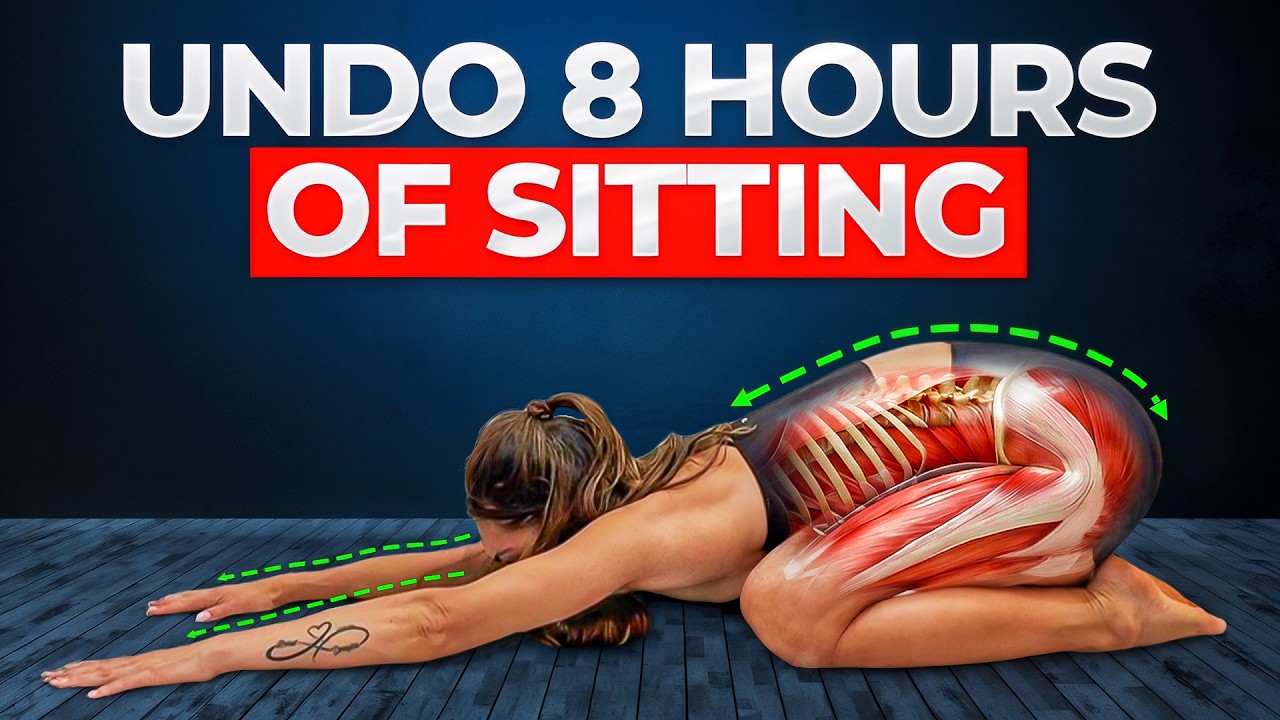
- Start with child's pose lateral reaches to create space in your rib cage and spine after long sitting periods.
- Incorporate cat-cow transitions to restore spinal movement, performing 10 reps slowly to feel each vertebra articulate.
- Practice supine knee circles for 30 seconds on each side to release hip tension accumulated from daily activities.
- Engage in dynamic low lunge flows, rocking back and forth for 30 seconds on each leg to lengthen hip flexors effectively.
- Finish with happy baby flow, rocking side to side to massage your spine and signal your body to relax before sleep.
Key Insights
- Passive stretching is ineffective after prolonged sitting; active movement through tension is essential for restoring mobility and preparing the body for recovery.
- The body's nervous system requires dynamic input to release tension, emphasizing the importance of movement over static positions in promoting physical well-being.
- Consistent 15-minute mobility routines can significantly improve sleep quality and reduce morning stiffness, highlighting the power of simple, regular practices over complex protocols.
- Understanding the body's asymmetries and restrictions during movement can provide valuable insights into daily habits and inform targeted restorative practices for better health.
- Transitioning from a day of tension to a night of recovery involves mindful movement, demonstrating the connection between physical activity and mental relaxation.
Summary Points
- Perform a 15-minute mobility routine to counteract the effects of sitting for 8 hours daily.
- Focus on active restoration through decompression, flow, and integration phases for better body function.
- Incorporate movements like child’s pose, cat-cow, and hip circles to release tension and improve mobility.
- Dynamic movements help your nervous system adapt and prepare for restful sleep and recovery.
- Consistent practice leads to improved sleep quality, reduced morning stiffness, and increased daily energy.
Detailed Summary
- The video introduces a 15-minute mobility routine designed to counteract the negative effects of sitting for extended periods, emphasizing the importance of active movement over passive stretching for optimal body recovery.
- The routine is structured into three phases: decompression, flow, and integration, each targeting different aspects of physical tension and promoting overall body restoration after a long day of sitting.
- In the decompression phase, exercises like child's pose with lateral reaches and cat-cow to downward dog are performed to create space in the spine and rib cage, enhancing mobility and relieving tension.
- The flow phase includes dynamic movements such as quadriped hip circles and low lunge flows, aimed at restoring hip mobility and encouraging the body to relearn natural movement patterns that may have been lost.
- The active pigeon pose and 9090 transitions are also featured, focusing on dynamic movement to release hip tension and improve internal and external rotation, which are crucial for overall body function.
- The integration phase incorporates exercises like supine pigeon bridge and happy baby flow, which help to relax the nervous system, promote recovery, and signal the body that it's time to transition into sleep.
- Throughout the routine, the importance of listening to the body and moving gently through tension is emphasized, allowing for gradual release and improved range of motion without forcing any positions.
- The video concludes by encouraging viewers to practice this routine consistently, highlighting the long-term benefits such as improved sleep quality, reduced morning stiffness, and increased daily energy levels.
What is the main purpose of the 15-minute mobility routine presented in the video?
Which phase of the routine involves creating space in the body?
What is the recommended way to perform the cat cow to downward dog transition?
During the supine knee circles, what is the primary focus?
What should you do if you feel tightness during the active pigeon pose?
How long should each side be worked on during the low lunge flow?
What is the significance of the 9090 transitions in the routine?
What does the happy baby flow aim to achieve?
What is the overall message regarding the routine's frequency?
What is the recommended approach to breathing during the mobility routine?
What is the main purpose of the 15-minute mobility routine?
The routine aims to undo the damage caused by sitting for long hours, improve sleep quality, reduce morning stiffness, and promote body recovery overnight.
Why is passive stretching ineffective after a day of sitting?
Passive stretching does not effectively address the tension built up in the body from being locked in one position. Active movement through tension is needed to restore mobility and provide new movement information to the nervous system.
What are the three phases of the mobility routine?
The three phases are decompression, flow, and integration. Each phase serves to create space in the body, restore range of motion, and prepare the nervous system for sleep.
Describe the decompression phase of the routine.
In the decompression phase, exercises like child's pose with lateral reaches and cat-cow movements are performed to create space between the ribs and vertebrae, allowing the spine to regain its natural movement.
How does the cat-cow exercise benefit the spine?
The cat-cow exercise promotes spinal hygiene by encouraging movement through flexion and extension. It helps restore the natural range of motion lost from prolonged sitting.
What is the purpose of supine knee circles?
Supine knee circles help release tension in the hips and lower back. This gentle rotation allows for exploration of movement and relaxation of tight areas without forcing the body.
What is the significance of the low lunge flow?
The low lunge flow dynamically teaches hip flexors to lengthen and shorten, counteracting the shortening that occurs from prolonged sitting. It encourages movement rather than static stretching.
Explain the active pigeon pose in the routine.
In the active pigeon pose, the individual rocks forward and back instead of holding the position. This dynamic movement helps release tension in the hips and engages the nervous system effectively.
What are 90/90 transitions and their importance?
90/90 transitions involve moving slowly between two 90-degree hip positions. They enhance hip mobility and control, addressing the loss of independent hip movement caused by sitting.
How does the supine pigeon bridge contribute to overall body relaxation?
The supine pigeon bridge stretches the posterior chain, including the hips and lower back. It promotes relaxation through gentle pressure and breath, helping to release accumulated tension.
What is the role of the happy baby flow in the routine?
The happy baby flow involves rocking side to side while holding the feet, which massages the spine and releases tension. It signals the body to relax and transition into sleep.
What are the long-term benefits of practicing this routine consistently?
Consistent practice of the routine can lead to improved sleep quality, reduced morning stiffness, increased energy levels throughout the day, and a general feeling of well-being in the body.
Why is movement considered essential for recovery after sitting?
Movement is essential for recovery because it helps restore range of motion, reduces tension, and provides the nervous system with the information needed to downregulate and prepare for rest.
How long should the mobility routine be practiced each night?
The mobility routine should be practiced for just 15 minutes each night to effectively counteract the effects of prolonged sitting and promote overall body health.
Study Notes
The video introduces a 15-minute mobility routine designed to counteract the negative effects of sitting for long periods, specifically for those who spend 8 hours a day at a desk. The presenter emphasizes that this routine is not about passive stretching but rather about active restoration through movement. This approach is crucial for improving sleep quality and reducing morning stiffness, as it encourages the body to recover overnight instead of remaining tense and locked up. Viewers are encouraged to follow along to learn how to effectively implement this routine into their nightly practices.
The mobility routine is structured into three distinct phases: decompression, flow, and integration. Each phase serves a specific purpose in restoring the body's natural movement patterns that are often lost due to prolonged sitting. Decompression focuses on creating space in the body, flow emphasizes moving through that space to restore range of motion, and integration prepares the nervous system for sleep. Understanding these phases is essential for maximizing the benefits of the routine and ensuring a holistic approach to body maintenance.
The first exercise in the decompression phase is the child's pose with lateral reaches. This position helps stretch the side body, rib cage, and lats, which often become tight from sitting. The presenter advises viewers to breathe deeply and allow their bodies to open up gradually, emphasizing the importance of listening to the body's signals. Completing 10 reps on each side helps create space between the ribs and vertebrae, counteracting the compression experienced throughout the day. This exercise sets the foundation for the rest of the routine.
Following the child's pose, the routine progresses to the cat-cow transition into downward dog. This movement is performed slowly, focusing on spinal hygiene by allowing each vertebra to articulate through flexion and extension. The presenter highlights the importance of this exercise in restoring the natural movement of the spine, which is often lost due to prolonged sitting. Viewers are encouraged to perform 10 reps, paying attention to areas that feel stuck or smooth, as this feedback is crucial for understanding their body's needs.
Next, the routine includes supine knee circles, where participants lie on their backs and make small circles with their knees. This gentle movement helps release tension in the hips and lower back, which can accumulate from daily activities. The presenter advises starting with small circles and gradually increasing the size, emphasizing the importance of exploration rather than force. This exercise lasts for 30 seconds on each side and is vital for loosening the hips and preparing for the next phase of the routine.
In the slow flow phase, participants perform quadriped hip circles while on their hands and knees. This exercise focuses on hip mobility and encourages the separation of hip and spine movement, which is often compromised by sitting. Viewers are instructed to make both large and small circles, paying attention to any restrictions in movement. This exercise lasts for 30 seconds on each side and is crucial for restoring independent hip flexion, which supports overall body mechanics.
The low lunge flow involves transitioning in and out of a low lunge position, rocking forward, backward, and side to side. This dynamic movement helps lengthen and shorten the hip flexors, which become tight from sitting. The presenter encourages participants to listen to their bodies and adjust the depth of their movements based on their comfort level. This exercise is performed for 30 seconds on each leg and is essential for restoring mobility in the hips and improving overall movement patterns.
Next, the routine introduces an active pigeon pose where participants lean forward and rock side to side. This movement provides dynamic input to the hips, which is necessary for releasing tension. The presenter emphasizes the importance of movement over static holding, allowing the body to respond naturally. Participants are advised to complete 10 controlled reps on each side, focusing on comfort and gradual release of tension in the hips.
The integration phase begins with the supine pigeon bridge, where participants place one shin across the opposite knee and gently lift their hips. This position helps release tension in the posterior chain, including the hips, glutes, and lower back. Viewers are encouraged to breathe deeply and allow gravity to assist in the release. Switching sides helps identify asymmetries in the body, which is a normal part of the process. This exercise is crucial for preparing the body for restful sleep.
The video concludes by summarizing the benefits of the 15-minute routine, emphasizing that it transforms the body from a state of compression to one that is open and ready for recovery. Regular practice of this routine can lead to improved sleep quality, reduced morning stiffness, and increased energy throughout the day. The presenter encourages viewers to incorporate this simple yet effective movement practice into their nightly routine for long-term body maintenance and overall well-being.
Key Terms & Definitions
Transcript
In this video, I'm going to show you a 15-minute mobility routine that will completely undo the damage caused by sitting at a desk for 8 hours every single day. 15 minutes. That is all you need to fix your body. So, stick with me until the end of this video to see how. Most people who attempt to do nighttime routines take it by doing stretching. They hold positions. They wait for their muscles to relax. But for the most part, your body doesn't respond well to passive stretching after a full day of being locked up in one position. Your body needs to move through the tension, not just sit in it. And when you've been compressed all day, hunched over a computer, locked into a car seat, or sitting in meetings, your nervous system is stuck in that pattern. So, we need to give it new information, movement information. So, this is 15 minutes of active restoration. We're going through three different phases. decompression, flow, and integration. Everything's connected. We are treating your body like the system that it is. If you do this routine, your sleep will improve. Your morning stiffness will decrease. Your body will actually recover overnight instead of just staying locked up. So, let's go. Starting with ground decompression. You're going to get into a child's pose and you're going to do lateral reaches. Reach your arms to one side. Feel that stretch through your entire side body. Your rib cage, your lats, all the way down to your hip. You've been compressed all day. Your rib cage barely moved. Your spine was locked in the same position for hours. We are creating space, actual space between your ribs and your vertebrae. So breathe into it. Don't force anything. Just let your body open up. Switch sides. Notice if one side feels tighter. That's information about how you've been moving or not moving all day. Stay here. Breathe. Let each breath create a little more space. You will do 10 reps on one side and 10 reps on the other side. Next, we move into cat cow to downward dog. You're going to do this very slowly. Start from your tailbone. Let the movement wave through each vertebra one at a time all the way up to your neck. This is spinal hygiene. Your spine is designed to move through these ranges, flexion and extension, but most people lose this because they spend all day in one locked position. Don't rush it. Feel each section of your spine as it moves. This will completely open up your whole posterior chain. Some areas will feel smooth, some will feel stuck. Both are fine. You are just gathering information. Every rep is restoring movement that your spine should have but probably lost. You're going to complete 10 reps of the transition up and down, making sure to push your hands away from the ground at each top position. Next, we move into supine knee circles. On your back, laying down, bring your knees to your chest. Start to make small circles with your knees. Let your hips move freely. Your lower back stays relaxed against the floor. Start small, then gradually make the circles bigger. Your hips carry tension from everything that you did today. Sitting, standing, walking, even how you slept the night before. This gentle rotation is how you release it. No force, just exploration. Feel your lower back releasing against the floor. Feel the tension melting out of your hips. You're going to perform 30 seconds to one side and 30 seconds to the other side. That decompression phase just created space in your body. And now we're going to move through that space and restore the range of motion that you've been missing. Now we're going to move into the slow flow, the quadriped hip circles. Position yourself on your hands and knees. Make slow circles with your hips. Let your hips lead the movement. Your spine follows naturally. Everything else is just along for the ride. Most people move their hips and spine as one locked unit. They've forgotten how to separate the movement. This is how you remember. This is how you restore natural independent hip flexion. Try to make big circles. Try to make small circles. See where you feel restricted. That restriction, that's your body telling you where you need more work. So, listen to it. Absorb it. You're going to perform 30 seconds to one side and 30 seconds to the other side. Next, we move into the low lunge flow. Now, we will drop into a low lunge, but we are not holding a static position here. You're going to rock forward and backwards, side to side. Explore that position. Your hip flexors have been shortened all day from sitting. We're not just stretching them here. We are teaching them to lengthen and shorten dynamically again. So, allow your body to guide you. Some days you'll want to go deeper. Some days you'll stay small. And there's no right answer. just what your body needs today. Feel the front of your hip opening, not because you're forcing it, but because you are giving it movement. You're going to perform 30 seconds on one leg and 30 seconds on the other. Now, we move into the active pigeon pose, but we're moving through it, not just holding it. So, you're going to lean forward and come back up. Rock side to side. Your hip needs movement to release, not just static pressure. That's how your nervous system works. It responds to dynamic input. So feel your hip open gradually. Feel the tension releasing. Don't push it. Don't force it. Just keep moving through the position and allow your body to respond. Some areas will release immediately. Some will take some time. Both are normal. Ensure that the weight of your body remains forward and there's not much use of your hands or anything else for support. Go as low as you are comfortable. And if you feel tension, you can elevate your foot onto a bench or a couch slightly. Complete 10 controlled reps on each side. Next, we move into the 9090 transitions. You're going to sit in a 9090 position, both hips at 90°. Now, transition slowly from one side to the other. Control the movement. Don't just flop over. This is hip mobility in its purest form. Complete control internal and external rotation. the movements that your hips lose first from sitting. Take your time. Feel the range of motion improving with each transition. Your hips are the foundation of everything else in your body. When they move well, everything else works better. When they don't, everything compensates. You're going to complete a total of 20 transitions, 10 per side. So, up to this point, your body has moved through tension. Now, we integrate everything and prepare your nervous system for sleep. We're going to start with supine pigeon bridge. So, you're going to get back onto your back, pigeon position. Place one shin across the opposite knee and push it the knee towards the floor. Then, lift the hips up gently, just enough to feel the stretch. Breathe into it. Feel the release through your entire posterior chain. Your hip, your glute, your lower back, even up your midback. Everything is connected. When you release one area, the tension in everything else decreases, too. Don't push too hard. Allow gravity and your breath to do the work. Your body knows how to release. You just have to give it the time. Switch sides and notice the difference. One side is always tighter. That's completely normal. That's your body's asymmetry showing up. Then we move into the happy baby flow. We're going to finish here. Grab your feet rock side to side. You're massaging your spine against the floor, letting the movement work through any remaining tension. Your back releases, your hips open, your entire nervous system starts downregulating. This gentle rocking motion signals to your body that it's safe to let go, that the day is done. Stay here as long as you want. Play around with different movements. Let the movements slow down naturally. Let your breathing slow down, too. This is how you transition from your day into your night. Not locked up, not tense, open and ready for sleep. And there you have it. 15 minutes decompression flow integration. You just took your body from compressed and locked up to open and ready to recover. You moved through tension instead of just sitting in tension. You restored range of motion that sitting all day destroys. Your nervous system got the information that it needed to downregulate to prepare for actual recovery overnight. Do this routine consistently and watch what happens. Your sleep quality will improve. Your morning stiffness will disappear. You will have more energy throughout the day and your body will actually feel different. This is how you maintain your body for the long term. Not through complicated protocols, but through simple, consistent movement practice. And guys, 15 minutes is all it takes every single night. That's all you have to do. So, enjoy the routine, practice it, and I'll see you in the next video. Let me know in the comments how it worked for you and what kind of routines you want to see
Title Analysis
The title uses a straightforward question format that invites curiosity without employing sensational language or exaggeration. There are no ALL CAPS or excessive punctuation, and while it does create a curiosity gap about what to do before bed, it remains relevant to the content of the video. The title is somewhat attention-grabbing but does not resort to extreme clickbait tactics.
The title accurately reflects the content of the video, which focuses on a mobility routine to counteract the effects of prolonged sitting. The promise of a solution to the issues caused by sitting for long hours aligns well with the instructional nature of the video. However, it could be slightly misleading as it implies a singular action ('Do This') rather than a series of exercises.
Content Efficiency
The video presents a high density of unique and valuable information, particularly in the description of the mobility routine and its benefits. While there are some repetitive phrases, especially regarding the importance of movement and the body's response to tension, the majority of the content is focused on specific exercises and their purposes. The unique information ratio is strong, as most of the content directly relates to the mobility routine, with minimal filler.
The pacing of the video is generally good, with clear instructions and explanations for each exercise. However, some sections could be streamlined, as certain points are reiterated multiple times, which may detract from overall time efficiency. While the content is mostly concise, a few elaborations on the benefits of the exercises could be shortened without losing essential information, leading to a more efficient delivery.
Improvement Suggestions
To enhance information density, consider reducing repetition by consolidating similar points about the benefits of movement and the body's response to sitting. Additionally, streamline the explanations of each exercise to focus on key instructions and outcomes, minimizing any tangential comments. This could help maintain viewer engagement and improve the overall time efficiency of the video.
Content Level & Clarity
The difficulty level is assessed at a 3 because the content is accessible to most individuals with basic familiarity with physical movement and stretching. The instructions are straightforward, and while some anatomical understanding may enhance the experience, it is not strictly necessary. The exercises are designed for general audiences, particularly those who sit for long periods, making it suitable for beginners looking to improve their mobility.
The teaching clarity is rated at a 9 due to the clear structure and logical flow of the content. The instructor uses simple language and provides detailed explanations for each movement, making it easy for viewers to follow along. The transitions between exercises are smooth, and the rationale behind each movement is well-articulated, enhancing understanding. However, a slight improvement could be made by summarizing key points at the end of each phase to reinforce learning.
Prerequisites
Basic familiarity with physical movement and stretching techniques would be helpful, but no specific prior knowledge is required.
Suggestions to Improve Clarity
To enhance clarity and structure, consider adding visual aids or on-screen text to highlight key points during each exercise. A brief recap of the benefits of each movement at the end of the video could reinforce learning. Additionally, including modifications for different fitness levels could make the routine more inclusive, catering to a broader audience.
Educational Value
The video provides a highly educational experience focused on a 15-minute mobility routine designed to counteract the negative effects of prolonged sitting. It offers factual information about the body's response to sitting and emphasizes the importance of active movement over passive stretching. The teaching methodology is practical, with clear instructions for each exercise, promoting engagement through active participation. The depth of content is commendable, as it covers various phases of mobility (decompression, flow, integration) and explains the physiological benefits of each movement. Knowledge retention is facilitated through the routine's simplicity and the encouragement of self-awareness regarding body tension. The practical application is evident, as viewers can immediately implement the routine to improve their sleep quality and overall well-being, making it a valuable resource for those with sedentary lifestyles.
Target Audience
Content Type Analysis
Content Type
Format Improvement Suggestions
- Add visual aids to demonstrate movements
- Include on-screen text for key points
- Incorporate a timer for each exercise
- Provide a summary of benefits at the end
- Offer variations for different skill levels
Language & Readability
Original Language
EnglishVery easy to read and understand. Simple language and clear explanations.
Content Longevity
Timeless Factors
- Focus on health and wellness: The content addresses the universal need for physical well-being, which remains relevant regardless of trends.
- Simple and accessible routine: The 15-minute mobility routine is easy to follow and can be integrated into anyone's daily life, making it perpetually useful.
- Addressing common issues: The content tackles the widespread problem of the negative effects of prolonged sitting, a concern that is unlikely to diminish over time.
- Promotes self-care: The emphasis on self-care and body awareness is a timeless concept that resonates with audiences across different generations.
- Movement as a fundamental principle: The idea that movement is essential for health and recovery is a foundational principle that will always be relevant.
Occasional updates recommended to maintain relevance.
Update Suggestions
- Incorporate new research findings on mobility and health to enhance credibility and relevance.
- Update the routine with variations or modifications to cater to different fitness levels or emerging trends in wellness.
- Add testimonials or success stories to provide social proof and encourage engagement.
- Reference current technology or tools that can enhance the mobility routine, such as apps or wearables.
- Include seasonal or situational adaptations for the routine, addressing how it can be tailored to different lifestyles or environments.